




A Cosmic Neighbor with a Violent Past
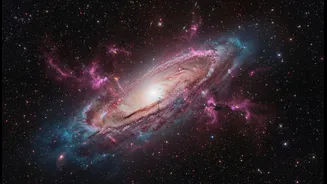
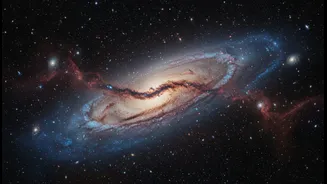
Located about 11 million light-years away, Centaurus A is a cosmic celebrity for astronomers. It's relatively close, but unlike most nearby galaxies, it is incredibly active, making it a perfect natural laboratory for studying some of the universe's most dramatic
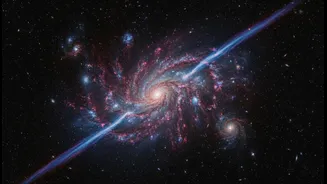
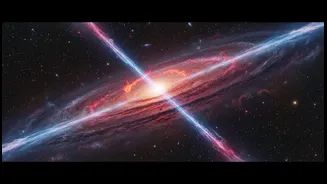
processes. Scientists have long known that Centaurus A is the product of a massive collision between two galaxies that occurred roughly two billion years ago. This merger left behind a chaotic jumble of gas, dust, and stars, and fed the supermassive black hole at its center, which continues to launch powerful jets of energy into space.
Peering Through the Dust
Previous attempts to study Centaurus A’s core were frustrated by thick bands of dust that block visible light, leaving telescopes like Hubble with an incomplete picture. While earlier infrared observatories like the Spitzer Space Telescope could see large-scale structures, they lacked the sharpness to resolve fine details or individual stars. This is where the James Webb Space Telescope (JWST) changes the game. Using its advanced Mid-Infrared Instrument (MIRI) and Near-Infrared Camera (NIRCam), Webb cuts through the obscuring dust with incredible clarity. The result is a breathtakingly detailed landscape of millions of individual stars, glowing gas, and intricate dust structures never seen before.
What the New Image Reveals
The new images are more than just beautiful; they are packed with scientific information. Webb's view has exposed a warped, parallelogram-shaped disk of glowing dust at the galaxy's center, which is a remnant of the ancient collision. It also highlights stellar nurseries—regions where new stars are forming within the dust lanes. Perhaps most intriguing is a mysterious, faint S-shaped structure near the core, the origin of which scientists are now trying to understand. By resolving millions of distinct stars, astronomers can now engage in a kind of galactic archaeology, creating a timeline of the galaxy's evolution by studying stars of different ages.
A Tale of Creation and Destruction
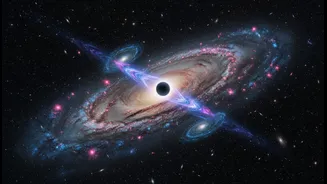
At the heart of Centaurus A lies its supermassive black hole, which is actively consuming the gas and dust supplied by the past merger. Webb's instruments can do more than just take pictures; they can measure the movement of gas around this cosmic engine. Early findings show fast-moving gas being blasted outward from the core, likely driven by the black hole's immense energy. At the same time, Webb observed a rotating disk of warmer gas closer to the black hole. This provides a direct look at the complex relationship between a black hole and its host galaxy—a process where the black hole can both trigger star formation by compressing gas and stifle it by blowing away the raw materials.