

Earth's Unforgiving Twin
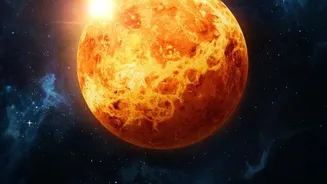
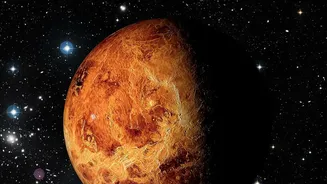
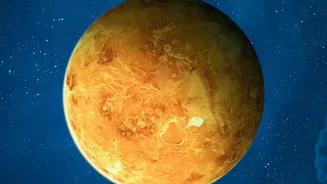
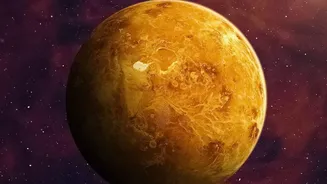
At first glance, Venus and Earth are remarkably similar. They are close in size, mass, and composition, suggesting they were born from the same cosmic materials. But their evolutionary paths diverged dramatically. Today, Venus is a cautionary tale of
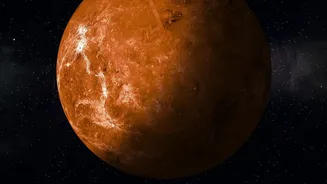
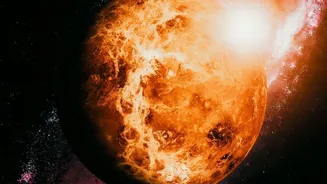
a runaway greenhouse effect. Its atmosphere, over 90 times denser than Earth's and composed of 96% carbon dioxide, traps heat and creates a scorching surface temperature of around 467°C. Thick clouds of sulfuric acid permanently shroud the planet, hiding a landscape shaped by intense volcanic activity. It is this very activity, however, that makes Venus so valuable to scientists trying to piece together the history of our own world.
Reading the Chemical Fingerprints in the Air
Scientists can learn a lot about a planet's geology by studying its atmosphere. On Venus, one of the most revealing chemical clues is sulfur dioxide (SO₂). On Earth, SO₂ is a common gas released by volcanic eruptions, but it gets washed out of our atmosphere relatively quickly by rain. Venus, however, is incredibly dry. Its upper atmosphere is bombarded by sunlight, which should break down any SO₂ present. Yet, missions like the European Space Agency's Venus Express have detected not only fluctuating levels of sulfur dioxide but also a mysterious layer of it high in the atmosphere, suggesting it is being actively replenished from a source below.
The Smoking Gun: Active Volcanoes
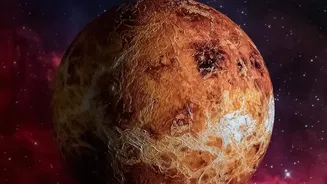
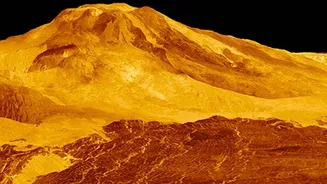
The most logical source for this continuous supply of sulfur dioxide is active volcanism. For decades, scientists debated whether Venus's volcanoes were ancient relics or still fuming. The debate was largely settled when researchers, analyzing archival radar images from NASA's Magellan mission of the 1990s, found direct evidence of a volcanic eruption. Images taken eight months apart showed a volcanic vent near the volcano Maat Mons that had changed shape and nearly doubled in size, consistent with an eruption or the movement of magma just below the surface. This discovery confirms that Venus is geologically alive, providing a dynamic natural laboratory for processes that once dominated our own planet.
A Window into Earth's Lost Youth
Studying active volcanism on Venus is critical because it offers a proxy for early Earth. Our planet's first billion years were likely far more volcanic and hostile, a period from which almost no geological record survives. Earth’s system of plate tectonics constantly recycles the crust, erasing the evidence of its ancient surface. Venus, which does not appear to have plate tectonics, has a surface that seems to have been globally resurfaced by lava flows around 500 million years ago, preserving a different kind of geological history. By observing the chemical signatures of volcanism in Venus's atmosphere and the geological changes on its surface, scientists can better understand how a rocky planet's interior shapes its crust, drives its evolution, and impacts its climate without the complexities of plate tectonics.
A New Era of Venus Exploration
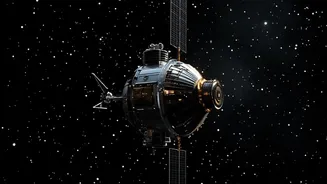
A trio of upcoming missions promises to revolutionize our understanding of Earth's twin. NASA is sending two missions, VERITAS and DAVINCI. VERITAS will orbit the planet and create detailed 3D maps of its surface, confirming whether processes like volcanism are still active. The DAVINCI mission includes a probe that will descend through the thick atmosphere, directly measuring its chemical composition to understand how it formed and evolved. Complementing them is the ESA's EnVision mission, which will also orbit Venus to provide a holistic view of its core, surface, and atmosphere, helping to finally explain why it became so different from Earth.