



The Solar System’s Frozen Frontier
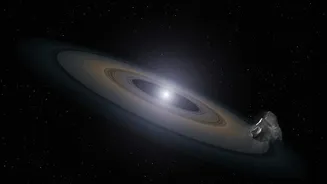
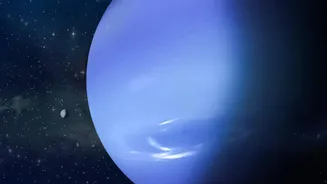
Beyond the orbit of Neptune lies a vast, frigid region known as the Kuiper Belt. Think of it as a cosmic deep freeze, a donut-shaped zone populated by millions of icy, rocky bodies that are leftovers from the formation of the solar system billions of years
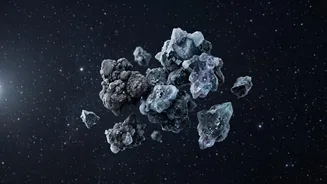
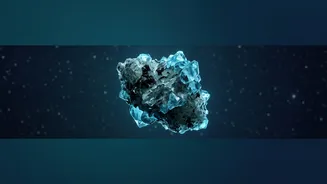
ago. While the asteroid belt between Mars and Jupiter is mostly rock and metal, Kuiper Belt Objects (KBOs) are primarily composed of frozen materials like water, methane, and ammonia. This realm, home to dwarf planets like Pluto, holds the primordial building blocks of planets, offering a pristine record of the conditions in which our world was born. Scientists study this area to understand not just how planets form, but how our entire cosmic neighbourhood evolved.
A Lonely Journey Counting Dust
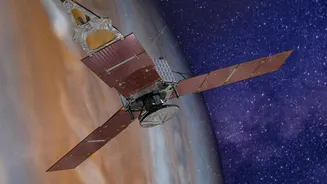
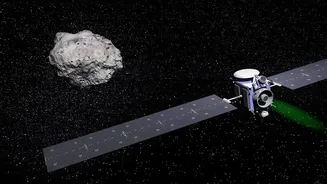
Launched in 2006, NASA’s New Horizons spacecraft has become humanity’s farthest robotic explorer of this outer realm. After its historic flyby of Pluto in 2015, it has continued its journey outward. Onboard is a special instrument called the Venetia Burney Student Dust Counter (SDC), the first science instrument on a planetary mission designed and operated by students. Its mission is simple but profound: to count the microscopic dust particles it collides with. These dust grains are created when larger KBOs crash into each other or when they are peppered by particles from outside the solar system. By measuring the density of this dust, scientists can create a map of where the material in the outer solar system is located, effectively taking a census of this distant region.
Where the Dust Was Supposed to End
For years, scientific models painted a relatively clear picture of the Kuiper Belt's structure. Based on telescopic observations, it was thought that the main part of the belt had an 'outer edge' at around 50 astronomical units (AU) from the Sun—an AU being the distance between Earth and the Sun. Beyond this point, the number of KBOs was expected to decline sharply. Logically, if there are fewer objects to collide with, there should be less dust. As New Horizons traveled past 50 AU, researchers expected the SDC instrument to register a significant drop in dust impacts, confirming the edge of this vast debris field. This would have validated existing models about the extent of our solar system's original planet-forming disk.
A Surprising and Dusty Twist
But the solar system had a surprise in store. As New Horizons journeyed through the region from 45 to 55 AU, its dust counter started detecting something unexpected. Instead of falling, the dust levels were significantly higher than any of the models had predicted. The 'empty' space beyond the supposed edge of the Kuiper Belt wasn't empty at all; it was still surprisingly dusty. The readings were so consistent and clear that they challenged the long-held consensus. “New Horizons is making the first direct measurements of interplanetary dust far beyond Neptune and Pluto, so every observation could lead to a discovery,” said Alex Doner, the SDC lead at the University of Colorado Boulder. This wasn't a minor deviation; it was a sign that the map needed to be redrawn.
What Does the Extra Dust Mean?
This excess dust opens up fascinating new possibilities. The most compelling theory is that the Kuiper Belt itself is much larger than we thought. Instead of ending at 50 AU, its population of icy rocks may extend as far as 80 AU or even farther. More objects colliding over a wider area would naturally produce the extra dust New Horizons is detecting. Some scientists have even floated the idea that there could be a second, entirely separate Kuiper Belt beyond the main one. While other, less likely explanations exist—such as radiation from the Sun pushing dust farther out than expected—the evidence is mounting for a larger, more populated outer solar system. These findings align with recent ground-based telescope searches that have also spotted KBOs in this unexpectedly distant region.