




A Sweet Discovery in a Violent Place
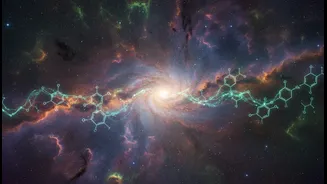
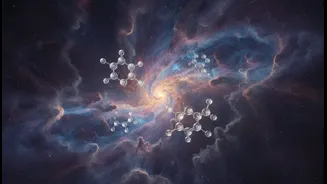
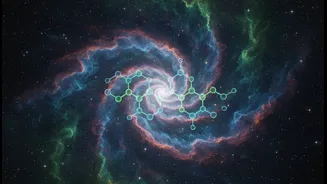
Scientists have detected a simple sugar called erythrulose floating in a massive cloud of gas and dust some 27,000 light-years from Earth. This molecular cloud, known as G+0.693-0.027, is located near the galactic core, a turbulent region of intense radiation
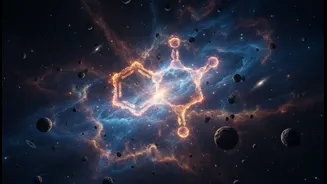
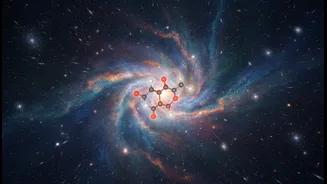
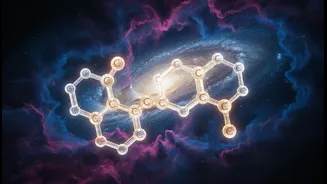
and star formation. Using powerful radio telescopes in Spain, an international team identified the unique radio frequency 'fingerprint' of erythrulose, a four-carbon sugar also found in raspberries. This marks the first time a true sugar has been unambiguously identified in the interstellar medium—the space between stars. While simpler related molecules like glycolaldehyde had been found before, erythrulose is a more complex structure, bringing us a step closer to the molecules that form the basis of life.
Why Sugar in Space Matters
On Earth, sugars are fundamental to life. They provide energy, form structural components of cells, and, most importantly, are a key part of our genetic material. The ribose sugar, for example, forms the very backbone of RNA, a molecule essential for coding, decoding, and regulating genes. For decades, scientists have wondered how these crucial molecules first appeared on our planet. One prominent theory is that they didn't form on Earth at all, but were instead delivered here by comets and asteroids during a period of intense bombardment billions of years ago. Sugars like ribose and glucose have been found inside meteorites and on asteroid samples returned to Earth, lending strong support to this cosmic delivery theory. The detection of erythrulose in interstellar space provides a missing link, showing that these complex organic molecules can indeed form naturally in the cold, dark nurseries where stars and planets are born.
From Stardust to Planets
Star-forming clouds like Sagittarius B2 are immense stellar factories. Within these cold, dense clouds, tiny dust grains are coated with ice. These icy surfaces act like miniature chemical laboratories, allowing simple atoms to meet and combine into more complex structures. Over millions of years, this slow and steady chemistry can build an impressive inventory of prebiotic molecules—the chemical precursors to life. The discovery shows that even the violent environment near the galactic center can host these delicate building blocks. As these clouds collapse under gravity to form new stars and planetary systems, these organic-rich materials are incorporated into the planet-forming disks. Comets and asteroids are essentially leftover building materials from this process, preserving a chemical snapshot of the early solar system and carrying these vital ingredients across space.
A Universal Recipe for Life?
The discovery of erythrulose and other complex organic molecules far from our own solar system has profound implications. It suggests that the basic chemical ingredients for life are not unique to Earth but are widespread throughout the galaxy. The same processes that may have seeded our planet with the components needed for life could be happening in countless other star systems right now. Researchers estimate that vast quantities of this sugar could have been delivered to early Earth, potentially kick-starting the chemical journey toward the first living organisms. This doesn't mean life is everywhere, but it does mean that the raw materials are. The universe, it seems, is surprisingly well-stocked with the essentials. The detection opens the door to searching for even larger, more biologically relevant sugars like ribose in the interstellar medium, which would further strengthen the connection between cosmic chemistry and the origins of life.