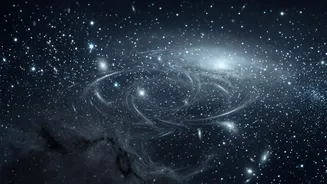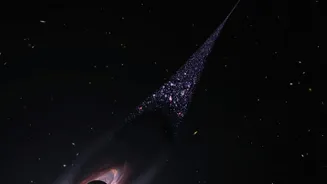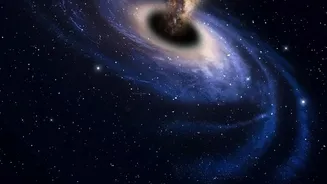



It’s one of the biggest mysteries in science: 85% of the matter in our universe is invisible. For years, a tidy explanation was that ancient, 'primordial' black holes were the culprit. But a growing body of evidence is taking that theory off the table.
What is Dark Matter, Anyway?
Dark matter is the mysterious stuff that scientists believe makes up about 27% of the universe. The 'normal' matter we can see and interact with—from stars and planets to us—accounts for only 5%. We can't see dark matter because it doesn't absorb, reflect, or emit any light. So how do we know it's there? The short answer is gravity. In the 1930s, astronomer Fritz Zwicky observed that galaxies in the Coma Cluster were moving so fast they should have flown apart. He theorised that some unseen 'dunkle Materie' (German for dark matter) was providing the extra gravitational glue needed to hold the cluster together. Decades later, in the 1970s, Vera Rubin's work on the rotation speeds of individual galaxies confirmed this; stars on the outer edges were moving far too quickly, implying a huge halo of invisible mass was present. Without this unseen matter, galaxies as we know them would have torn themselves apart long ago.
An Elegant Suspect: Primordial Black Holes
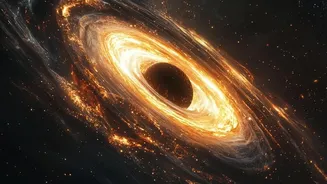
For a time, primordial black holes (PBHs) seemed like a perfect candidate for dark matter. Unlike the black holes we're familiar with, which form from the collapse of massive stars, PBHs are theoretical objects believed to have formed in the chaotic first moments after the Big Bang. In that primordial soup, incredibly dense pockets of matter could have collapsed directly into black holes of various sizes. This was an attractive idea for several reasons. First, PBHs are made of 'normal' matter, so they wouldn't require inventing new particles or new physics beyond the Standard Model. Second, they are, by definition, dark. Finally, they would have been created before the elements were even formed, aligning with cosmological models that suggest dark matter is non-baryonic (not made of protons and neutrons). The idea gained renewed interest after the first detection of gravitational waves from merging black holes by LIGO in 2015, which were more massive than expected.
The Evidence Piling Up Against Them
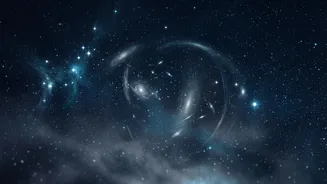
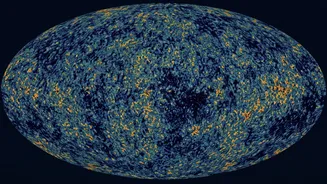
So what changed? The case against PBHs as the main source of dark matter comes down to observation. One of the most powerful tools for finding massive, dark objects is gravitational microlensing. When a massive object like a black hole passes in front of a distant star, its gravity acts like a lens, briefly and predictably magnifying the star's light. If the halo of our galaxy were filled with PBHs, surveys like the Optical Gravitational Lensing Experiment (OGLE) should have detected thousands of these microlensing events. They haven't. After years of observation, the number of events detected is far, far lower than what would be expected if PBHs made up all of the dark matter. One recent analysis concluded that if dark matter were composed entirely of 10-solar-mass black holes, they should have seen 258 events; they saw a fraction of that, all explainable by known stars and other objects. Other constraints from the analysis of the cosmic microwave background (the afterglow of the Big Bang) and the number of black hole mergers detected by LIGO and Virgo also severely limit the possible abundance of PBHs.
Not a Total Dead End
This doesn't mean primordial black holes don't exist at all. The evidence simply rules them out as making up the majority of dark matter, especially in the stellar-mass range. It's still possible that they exist in smaller numbers or within specific, narrow mass ranges that are harder to detect, such as the 'asteroid-mass' window. Some theories even suggest that while they can't be all of the dark matter, they could have played a crucial role in seeding the formation of the supermassive black holes we see at the centre of galaxies today. So, while they've been demoted from prime suspect to a minor player, the search for PBHs continues as a way to understand the early universe, even if they aren't the solution to the grand mystery of dark matter.
Back to the Other Suspects
With primordial black holes largely sidelined, the scientific searchlight turns back to other candidates. The leading contenders are hypothetical particles that require new physics. The most famous are WIMPs (Weakly Interacting Massive Particles), which, as the name suggests, are massive particles that interact only through gravity and any weak nuclear force. For years, large scale experiments have been trying to detect WIMPs so far without definitive success. This has led to a rise in popularity for another candidate axion Axions are hypothetical extremely lightweight particles that were originally proposed to solve a different problem in particle physics The hunt for dark matter is a process of elimination By ruling out a major contender like primordial black holes scientists can now focus their efforts more intensely on those strange exotic particles that might be shaping our cosmos from shadows