




Meet the 'Warm Neptunes'
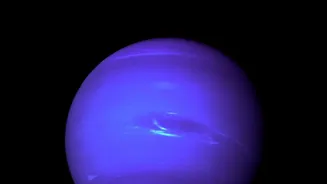
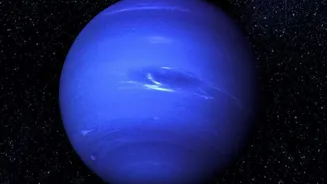
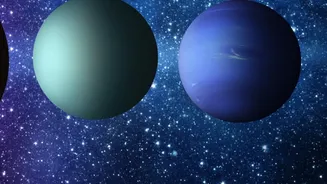
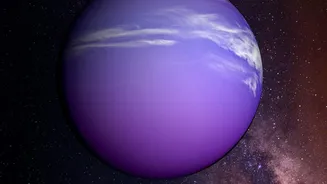
In the vast cosmic zoo of planets, some of the most common are worlds unlike any in our solar system. Meet the ‘warm Neptunes’—planets larger than Earth but smaller than Neptune, orbiting their stars at a close, toasty distance. Unlike our own ice giants,
Uranus and Neptune, which are far from the Sun, these worlds are heated to high temperatures. This proximity makes them prime candidates for study. As they pass in front of their host stars, telescopes like the JWST can analyze the starlight filtering through their atmospheres, a technique called transit spectroscopy. This method allows scientists to read the chemical barcode of a distant world's air, and recent findings have been both exciting and perplexing.
The Methane Puzzle
One of the most tantalizing molecules to find is methane (CH4). Here on Earth, the vast majority of methane is produced by living organisms, from microbes in wetlands to cows in fields. Because of this strong association with biology, methane is considered a potential 'biosignature'—a sign of life. However, it's not a smoking gun. Methane can also be produced by geological processes like volcanism. What makes methane so interesting to astrobiologists is its instability. In a planet's atmosphere, it is quickly broken down by sunlight, meaning that to be detected in large quantities, it must be constantly replenished. A massive, steady source is required, and on a rocky world, life is a very compelling explanation for such a source.
What the Telescope Is Seeing
The James Webb Space Telescope has been a game-changer. It recently detected methane and other molecules like water vapor and carbon dioxide in the atmospheres of several of these Neptune-like worlds, including WASP-107 b and GJ 1214 b. For a long time, the atmospheres of planets like GJ 1214 b were hidden by thick clouds or haze, but JWST’s powerful infrared vision has finally pierced the veil. The findings are often puzzling. On WASP-107 b, for example, scientists found far less methane than their models predicted for a planet of its temperature and composition. This suggests that unknown chemical reactions or unexpectedly vigorous mixing in its atmosphere are at play, driven by a surprisingly hot interior. These are not just observations; they are complex clues about the planet's internal engine and its history.
Informing the Search for Life
So, how does finding methane on a gassy, hot world inform the search for life on smaller, rocky planets? It's about refining the rulebook. Each time scientists detect a chemical cocktail on a world like a warm Neptune, they test and improve their models of planetary atmospheres. They learn which processes can create or destroy molecules like methane without life's involvement. For a biosignature to be convincing, scientists must be able to rule out non-biological explanations. Studies of these uninhabitable worlds provide a crucial catalogue of these 'false positive' scenarios. For instance, discovering that geological activity or unexpected heat can produce certain gas mixtures helps scientists know what to look for when they eventually point the JWST at a truly Earth-like world. The goal is to understand the context; a methane detection is only as good as our understanding of the planet it’s on.