







A Skeleton Within the Skeleton
Imagine the intricate wiring of a city's electrical grid. Now imagine that on a microscopic scale inside your brain, where billions of neurons connect. For a long time, scientists knew that neurons, like all cells, had a cytoskeleton to give them shape.
What they didn't know, until the advent of super-resolution microscopy, was that a second, more orderly skeleton was hiding in plain sight. Researchers discovered a remarkably periodic, lattice-like structure just beneath the neuron's membrane, especially along the axon—the long, slender fibre that transmits signals. This structure, now called the membrane-associated periodic skeleton (MPS), consists of evenly spaced rings of a protein called actin, connected by flexible spacers made of another protein called spectrin. It was a revelation; instead of a chaotic tangle, here was a beautifully organized scaffold, like the ribs of a ship's hull, providing both strength and flexibility.
Solving the Mystery of Axon Stability
One of the biggest puzzles in neurology was how axons, which can be thousands of times longer than the cell body is wide, survive. How do these incredibly thin, delicate extensions withstand the mechanical stress of our daily movements without snapping? The discovery of the MPS provided a compelling answer. This periodic structure of actin rings and spectrin links gives the axon a unique combination of robustness and flexibility. Think of it like a springy, reinforced tube. The structure is strong enough to maintain the axon's shape but flexible enough to bend and move without breaking. Before this discovery, our understanding of the axonal cytoskeleton was primarily focused on long filaments running its length, which didn't fully explain its resilience. The MPS, with its ring-like reinforcement, was the missing piece of the structural puzzle.
The Gatekeeper for Brain Health
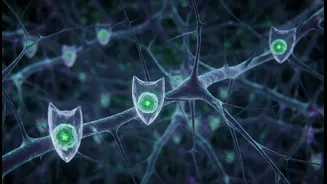
Initially, scientists thought the MPS was just a passive structural support. However, very recent research has revealed a much more active and crucial role: it acts as a gatekeeper. Neurons constantly absorb materials from their surroundings in a process called endocytosis, taking in nutrients and other essential molecules. A 2026 study from Penn State researchers showed the MPS actively regulates this process. It acts as a physical barrier, controlling where and when substances can enter the cell. When a neuron needs something, the 'gatekeeper' opens up to let it in. This was a groundbreaking shift in thinking. The skeleton wasn't just holding the cell together; it was managing traffic at its border, a critical function for neuronal health and communication.
A New Link to Alzheimer's and Parkinson's
This gatekeeper function has profound implications for neurodegenerative diseases like Alzheimer's and Parkinson's, which are characterized by the toxic buildup of aggregated proteins. The new research found that when the MPS is weakened or disrupted—a process that can happen during aging—it can trigger a dangerous feedback loop. A damaged MPS allows the neuron to take in harmful proteins, such as the amyloid precursor protein linked to Alzheimer's, at a much faster rate. Once inside, these proteins can be processed into toxic fragments that cause further damage, which in turn weakens the MPS even more, accelerating the degenerative cycle. This discovery suggests that the breakdown of this fundamental structure could be an early, hidden event in the progression of these devastating diseases. Before this, the link between the cell's physical structure and the accumulation of toxic proteins was not so clearly defined.
A New Target for Future Therapies
The discovery of the MPS and its active role as a gatekeeper doesn't just solve old mysteries; it opens up entirely new avenues for treatment. Instead of only focusing on clearing out toxic proteins after they've already accumulated, what if we could prevent them from getting into the cell in the first place? Scientists now believe that finding ways to protect and stabilize the MPS could be a powerful new strategy. By reinforcing this cellular gatekeeper, it might be possible to slow or even halt the destructive cycle that leads to neuron death. Researchers are now exploring this structure as a potential new protein target for therapies, hoping to preserve the integrity of the MPS and guard against the cellular changes that precede the symptoms of Alzheimer's and other neurological disorders.