





The Engine of Efficiency
There is no denying AI’s power. In workplaces across India and the globe, intelligent systems are revolutionising how we operate. AI excels at handling high-volume, repetitive, and data-intensive work with a speed and accuracy no human can match. It can analyse
massive datasets in minutes, automate tedious administrative duties like scheduling and report generation, and handle routine customer queries 24/7. Companies that effectively integrate these tools report significant time savings, often freeing up employees to focus on more meaningful work. The potential for AI to unlock trillions in productivity is real. From the factory floor to the finance department, AI acts as a tireless digital assistant, reducing operational costs and minimising human error in predictable tasks. It is, without a doubt, one of the most powerful tools for optimisation the business world has ever seen.
The Empathy Gap
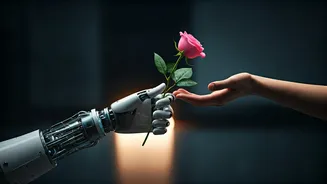
For all its analytical prowess, AI operates with a critical deficit: it has no feelings. It cannot replicate genuine empathy, nuanced understanding, or emotional intelligence. These aren't 'soft skills'; they are the very foundation of trust and collaboration. An AI can process a customer’s complaint, but it cannot truly sense their frustration or offer a solution that feels genuinely caring. It can analyse team performance metrics, but it cannot inspire a discouraged employee or build the psychological safety required for a team to take creative risks. This 'empathy gap' is where automation reaches its hard limit. Humans are biologically wired to connect with one another; neuroscientists point to mirror neurons that help our brains 'tune in' to each other's feelings. This biological hardware is essential for everything from negotiation and conflict resolution to effective leadership, and it's something code cannot simulate.
Where Connection Creates Value
The most successful businesses understand that loyalty is built on relationships, not just transactions. Consider customer service. While up to 85% of service leaders see AI transforming the customer experience, many consumers still prefer a human for complex or emotional issues. In fact, over half of consumers will switch to a competitor after just one bad service experience. A chatbot can reset a password, but a human agent can salvage a relationship with a frustrated long-term client by listening, understanding, and offering a flexible solution that a rigid algorithm would never allow. Research shows that companies prioritising human-centric customer relationships see higher satisfaction and retention rates. This same principle applies internally. True innovation isn't born from an algorithm; it comes from the messy, spontaneous, and trust-filled collaboration between people who feel safe enough to share their wildest ideas.
Augmentation, Not Replacement
The conversation should not be about automation versus humans, but about augmentation. The most intelligent way to deploy AI is not to replace people, but to empower them. The goal is to create a symbiotic 'human-agent ecosystem'. Let AI handle the predictable, repetitive, and cognitively draining tasks—the work a machine does best. This frees up human talent to focus on what they do best: strategy, creative problem-solving, building relationships, and connecting with other people. A study on AI in telemarketing found that when AI generated sales leads, it freed up employees to be more creative in their customer interactions, which in turn increased sales. This is the model for the future: AI as a collaborator that assists and augments human potential, allowing us to be more efficient and, paradoxically, more human.