

The Power of a Sunbeam
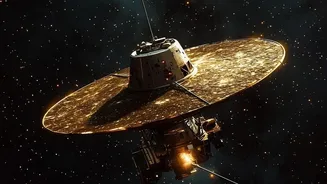
Conventional rockets are powerful but limited. They must carry all their fuel with them, making them incredibly heavy and restricting the length and scope of their missions. Solar sails offer a more elegant solution. Instead of burning fuel, they harness
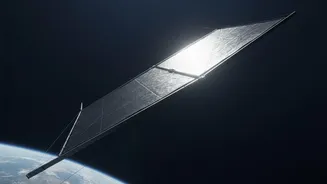
a fundamental force of nature: radiation pressure. Light is made of tiny packets of energy called photons. While photons have no mass, they do possess momentum. When a photon strikes a reflective surface, like a solar sail, it bounces off, transferring a tiny bit of its momentum to the sail. This push is incredibly small—at Earth's distance from the Sun, the force on a huge 800-by-800-metre sail is only about 5 newtons, roughly the weight of a small apple. But in the frictionless vacuum of space, these tiny pushes add up.
Constant Push, Limitless Fuel
The key advantage of a solar sail is its continuous propulsion. A rocket provides a massive, short burst of thrust, but a solar sail accelerates constantly and gradually. As long as it is exposed to sunlight, it is being pushed. This allows a spacecraft to build up tremendous speeds over time, far beyond what might be practical with chemical rockets alone. Since the 'fuel'—sunlight—is free and practically limitless, solar sails are ideal for long-duration missions. This eliminates the need for heavy propellant, significantly reducing launch costs and allowing for more scientific instruments to be carried onboard. By angling the sail, much like a sailboat tacking against the wind, a spacecraft can steer and navigate, even moving closer to the Sun if needed.
From Theory to Reality
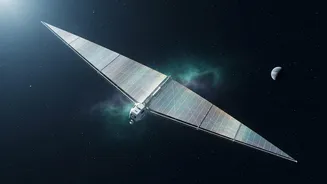
The concept of sailing on light has been proven by several missions. In 2010, Japan's IKAROS spacecraft became the first to successfully demonstrate controlled solar sailing in interplanetary space. More recently, The Planetary Society's LightSail 2, launched in 2019, successfully used a solar sail to change its orbit around Earth, proving the technology is viable even for small, low-cost satellites known as CubeSats. NASA has also been developing the technology, with its Advanced Composite Solar Sail System (ACS3) demonstrator deploying in 2024 to test new lightweight boom materials that could support sails as large as a soccer field in the future. These missions have moved solar sails from a theoretical idea to a tested and proven form of spacecraft propulsion.
Challenges on the Cosmic Ocean
Despite their promise, solar sails face challenges. The thrust is very weak, so they are not suitable for launching from Earth or for rapid manoeuvres. Acceleration is slow, and it can take weeks or months to perform an orbital change that a chemical rocket could do in minutes. The sails themselves must be enormous—hundreds or thousands of square metres—yet incredibly thin and lightweight, making them vulnerable to damage from micrometeoroids. Furthermore, their effectiveness diminishes the farther they travel from the Sun, as the sunlight becomes weaker. For missions to the outer solar system, the push would eventually become negligible.
The Future of Interstellar Travel
Looking ahead, solar sail technology could enable missions that are currently impossible. It could allow a spacecraft to hover in a fixed position relative to the Sun or Earth's poles, perfect for long-term solar weather monitoring or communications. An even more futuristic concept, known as beam sailing, proposes using high-energy, ground-based lasers to push the sails. This would provide a much stronger force than sunlight. The Breakthrough Starshot initiative, for example, aims to develop this idea to send a fleet of tiny 'nanocraft' to our nearest star system, Alpha Centauri. Pushed by a powerful laser array, these probes could theoretically reach 20% of the speed of light, making the interstellar journey in just over 20 years instead of tens of thousands.