


The Landing Problem
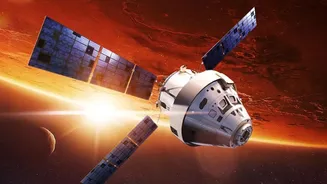
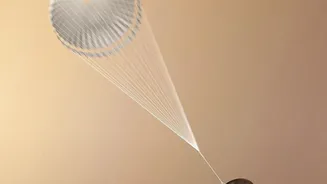
Sending missions to Mars, Venus, or even Saturn's moon Titan is an incredible feat. But the real challenge often begins in the final moments: landing. When a spacecraft hurtles towards a planet at hypersonic speeds, it needs to slow down dramatically.
The atmosphere provides a natural brake, but for it to work, you need a large surface area to create drag. Traditional heat shields are rigid and, crucially, limited by the size of the rocket they launch in. This has created a bottleneck, restricting the mass of payloads—like rovers, habitats, or scientific equipment—we can safely land on other worlds. For example, the atmosphere on Mars is about 100 times thinner than Earth's, making it incredibly difficult to generate enough drag for a heavy vehicle. To send the multi-ton payloads required for human missions, we need a bigger brake.
An Inflatable Solution
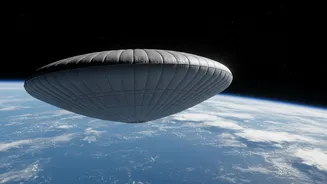
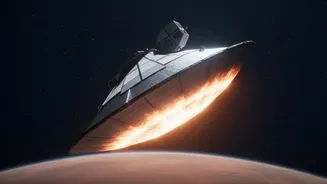
This is where inflatable heat shields, or Hypersonic Inflatable Aerodynamic Decelerators (HIADs), come in. The concept is elegantly simple: what if a heat shield could be packed into a small space and then deployed to a much larger size just before it's needed? Think of it less like a balloon and more like a super-strong, high-tech inflatable brake. Launched in a compressed state, it unfurls and inflates in space, creating a large, stable, mushroom-shaped shield. This larger surface area is far more effective at catching the upper layers of a planet's atmosphere, starting the deceleration process earlier and more gently. This allows the spacecraft to slow down significantly before needing to deploy parachutes or use retro-rockets, saving fuel and allowing for a much heavier payload.
From Packed to Puffed
The technology behind these shields is a marvel of materials science. The inflatable structure itself is made of stacked rings, or tori, woven from synthetic polymers that are incredibly strong—by weight, some are ten times stronger than steel. This allows the structure to be flexible enough to fold but rigid enough to maintain its shape when inflated with nitrogen gas. The side facing the intense heat of atmospheric entry is covered by a flexible thermal protection system. This shield is made of layers, including an outer layer of woven ceramic fibers, like silicon carbide, capable of withstanding temperatures up to 1,650°C (3,000°F). This advanced fabric protects the inflatable structure underneath, ensuring it survives the fiery plunge.
A Breakthrough Test Flight
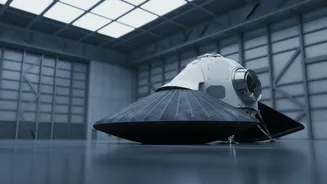
This technology went from theory to proven reality with NASA's Low-Earth Orbit Flight Test of an Inflatable Decelerator (LOFTID) mission. In November 2022, a 6-meter (20-foot) diameter inflatable aeroshell was launched into space. After inflating, it was sent hurtling back through Earth's atmosphere at over 18,000 miles per hour. The test was a huge success. The heat shield survived the intense heat and pressure, slowed down as predicted, and was recovered from the Pacific Ocean. The LOFTID mission successfully demonstrated that an inflatable heat shield could perform in a real-world scenario, proving the technology was ready for use on future missions. It was the largest blunt-body object to ever re-enter the atmosphere, paving the way for even bigger designs.
Unlocking the Solar System
The success of inflatable heat shields opens up a new era of planetary exploration. By overcoming the size limitations of rocket fairings, this technology will enable NASA and commercial partners to land heavier and more complex missions. For Mars, this could mean delivering the large habitats and supplies necessary for the first human crews, or landing in higher-altitude regions that are currently inaccessible. But the applications don't stop there. Missions to Venus, with its thick atmosphere, or Saturn's moon Titan, could benefit from this technology. It also has applications closer to home, providing a cost-effective way to return large assets or manufactured goods from low-Earth orbit. Ultimately, this innovation isn't just about a better heat shield; it's about making the next generation of ambitious deep-space missions possible.