





Learn to See in the Dark
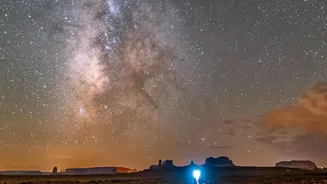
The first step to stargazing is simply learning to see. The single biggest barrier to a brilliant night sky is light pollution. To truly experience the cosmos, you need to find a spot away from city lights. Even in your backyard, turning off all house
and garden lights will make a significant difference. Once you're in the dark, give your eyes 20 to 30 minutes to adapt. During this 'dark adaptation' period, your pupils will fully dilate, and you’ll be able to see significantly more stars. Avoid looking at your phone screen, as the white light will instantly ruin your night vision. If you need a light, use a red torch, as red light has a much lower impact on your adapted eyes.
Get to Know Your Celestial Neighbours
Before you try to find distant galaxies, start by learning the prominent landmarks of the night sky. Focus on identifying a few key constellations. In the Northern Hemisphere, Ursa Major (containing the Saptarishi or Big Dipper) and Cassiopeia (shaped like a 'W') are visible year-round and are excellent starting points. Orion the Hunter, with its distinctive three-star belt, is a brilliant and easy-to-spot constellation in the winter sky. Learning these patterns is like learning the major roads of a city; once you know them, you can navigate to other, less obvious sights. These constellations act as celestial signposts, guiding you across the sky.
Use a Stargazing App as Your Guide
Technology can be a beginner's best friend. There are many fantastic stargazing apps available for smartphones that act as a portable planetarium. Apps like SkyView, Star Walk 2, and Stellarium use your phone's location and orientation to show you exactly what you're looking at in the sky in real-time. You can point your phone at a bright star, and the app will identify it, along with any nearby constellations or planets. Many apps also have a red-light mode to help preserve your night vision while you use them. These tools are invaluable for building confidence and making sense of the thousands of visible stars.
Find a Truly Dark Sky
To unlock the sky's full potential, you'll eventually want to venture away from the glow of urban and suburban areas. Light pollution maps, available online through sites like LightPollutionMap.info, can help you find nearby locations with darker skies. These maps use a colour-coded system, often based on the Bortle scale, to show the severity of light pollution. Aim for areas marked as green, blue, or grey for the best viewing experiences. National and state parks are often excellent choices, as they are protected from excessive development and lighting. The International Dark-Sky Association also certifies parks and reserves around the world known for their pristine night skies.
Start with Binoculars, Not a Telescope
Many seasoned astronomers advise beginners to start not with a telescope, but with a good pair of binoculars. Binoculars are more affordable, portable, and offer a wide field of view, which makes finding objects much easier than through a high-magnification telescope. A standard pair of 7x50 or 10x50 binoculars are ideal for astronomy. They gather significantly more light than your naked eye, revealing stunning details. You can see craters on the Moon, the moons of Jupiter, and the beautiful star cluster of the Pleiades (Seven Sisters). Binoculars provide an intuitive, right-side-up view that helps you learn your way around before graduating to the complexities of a telescope.
Join a Local Astronomy Club
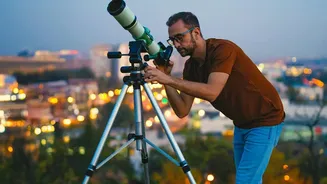
You don't have to learn about the universe alone. Joining a local amateur astronomy club is one of the most valuable steps you can take. Clubs are full of passionate, experienced observers who are eager to share their knowledge with newcomers. They often host regular meetings and public observing sessions where you can look through various types of telescopes and learn how to use them. This is the perfect opportunity to 'try before you buy' and figure out what kind of telescope might be right for you. The communal knowledge and social aspect can solve problems and answer questions far more effectively than any book or website.