
The Science of a Sun-Powered Push
At the heart of solar sailing is a concept called radiation pressure. Light, though it has no mass, is made of particles called photons that carry momentum. When these photons strike a surface, they transfer that momentum, exerting a tiny, continuous
push. While this force is incredibly small under normal circumstances—on Earth, it's easily overpowered by gravity and atmospheric drag—in the vacuum of space, it's a different story. By building a large, highly reflective sail, a spacecraft can catch these countless photons like a boat catching the wind, using the endless stream of sunlight to accelerate. This constant, gentle push is the key to achieving incredible speeds over time.
Designing a Sail for the Stars
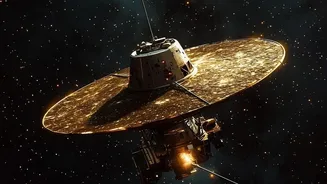
A solar sail is an marvel of engineering, fundamentally different from any conventional spacecraft component. It consists of vast, ultra-thin sheets of a reflective material, like a specially treated polyimide, stretched out over a lightweight but rigid frame. These sails must be enormous to catch enough sunlight to be effective, with some designs spanning the area of a small apartment or even a tennis court, all while being thinner than a human hair. The entire structure is designed to be incredibly light. It's launched into space folded into a compact package, often the size of a microwave oven, and then unfurled through a complex sequence of deployments. Missions like NASA's Advanced Composite Solar Sail System (ACS3) are currently testing new, lightweight composite booms designed to make these massive sails more reliable and efficient to deploy.
Slow and Steady Wins the Space Race
Unlike the explosive, short-lived bursts of chemical rockets, solar sails provide a very gradual acceleration. The initial push from sunlight is minuscule; for The Planetary Society's LightSail 2, the acceleration was just 0.058 millimeters per second squared. However, because the sun is always shining, that push is constant. Over weeks, months, and years, this continuous thrust allows a solar sail-powered craft to build up immense velocity, eventually surpassing the top speeds achievable by traditional rockets, which are limited by the amount of fuel they can carry. This method is not ideal for a quick trip to Mars, but for long-haul journeys to the outer solar system and beyond, the final speeds are unprecedented. Some projections suggest a solar sail probe could eventually travel five times faster than conventional rockets.
Pioneers and Future Voyages
Solar sailing has already moved from theory to proven technology. Japan's IKAROS mission, launched in 2010, was the first to successfully demonstrate solar sail propulsion in interplanetary space. More recently, The Planetary Society's crowdfunded LightSail 2 mission successfully used its sail to change its orbit around Earth, further proving the concept's viability for small satellites. Building on these successes, space agencies are planning even more ambitious missions. NASA's ACS3 demonstrator, which launched in April 2024, is testing key deployment technologies. Looking further ahead, missions like the proposed Solar Cruiser aim to use a massive sail, covering an area of over 1,600 square meters, to perform advanced science missions, like monitoring the sun for solar storms.