



The Challenge of a Closed System
On Earth, we take our vast, self-regulating atmosphere for granted. In the vacuum of space, however, providing breathable air is a constant logistical challenge. Simply shipping up tanks of oxygen is incredibly expensive and impractical for long-duration
missions. Every kilogram launched into orbit costs thousands of dollars. Instead, space agencies like NASA and ESA have developed sophisticated Environmental Control and Life Support Systems (ECLSS) that recycle the air, turning waste products into vital resources. The core of this challenge is dealing with the carbon dioxide (CO2) that astronauts exhale. If left to accumulate, it would quickly become toxic. The solution is not just to remove it, but to break it down and reclaim the oxygen within.
Step 1: Capturing Carbon Dioxide
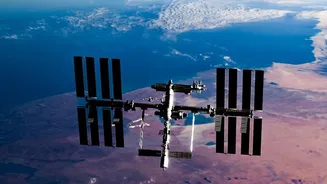
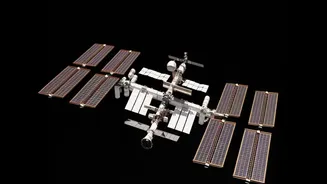
The first step in this process is to scrub the CO2 from the cabin air. The primary system used for this on the ISS is the Carbon Dioxide Removal Assembly, or CDRA. This refrigerator-sized unit uses beds of a porous, mineral-based material called zeolite. Cabin air is passed through these beds, which act like a molecular sieve. The zeolite has a high affinity for CO2 and water molecules, trapping them while letting purified air pass back into the station. The system is regenerative; it uses a process called "temperature swing adsorption," where one set of beds absorbs CO2 while another is heated to release the previously captured gas, which is then collected for the next stage.
Step 2: Making Water from Waste Gas
This is where the real chemical magic happens, inside a device using the Sabatier reaction, named after its discoverer, Paul Sabatier. The concentrated CO2 from the CDRA is sent to the Sabatier system. There, it's mixed with hydrogen, a byproduct from the station's main oxygen generator. This mixture is heated to high temperatures (around 300-400°C) over a catalyst, typically nickel or ruthenium. The chemical reaction that follows transforms the carbon dioxide and hydrogen into two new products: water (H2O) and methane (CH4). This ingeniously converts a harmful waste gas into precious water.
Step 3: Creating Oxygen Through Electrolysis
The water produced by the Sabatier reaction, along with water recycled from other sources like humidity and purified urine, is fed into the Oxygen Generation System (OGS). The OGS uses a process called electrolysis to split the water molecules (H2O) back into their constituent parts: breathable oxygen (O2) and hydrogen (H2). An electric current is passed through the water, causing it to separate. The oxygen is then piped back into the station's atmosphere for the crew to breathe. The hydrogen is recycled, sent back to the Sabatier system to react with more CO2, creating a nearly closed loop. This process is highly efficient but not perfectly so; some hydrogen is lost in the methane, which is currently vented into space, meaning a small amount of water or hydrogen still needs to be resupplied from Earth.
The Future of Life Support
This technology is more than just a clever solution for the ISS; it's a critical stepping stone for humanity's future in deep space. For missions to the Moon or Mars, where resupply from Earth would be nearly impossible, fully closed-loop life support is essential. NASA is already developing next-generation systems, like the SpaceCraft Oxygen Recovery (SCOR) project, which aims to recover hydrogen from the methane byproduct to achieve over 90% oxygen recovery, a significant improvement on the current 50%. Other experiments, like the Mars Oxygen In-Situ Resource Utilization Experiment (MOXIE) on the Perseverance rover, have already proven it's possible to generate oxygen directly from the carbon dioxide in the Martian atmosphere, paving the way for future explorers to "live off the land."