

More Than Just A Garnish
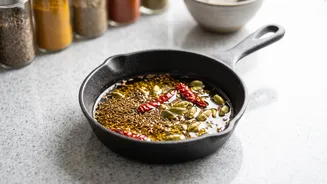
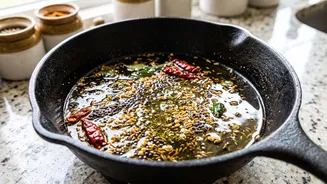
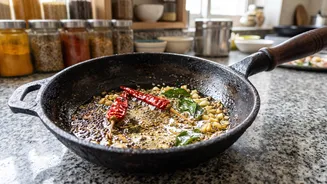
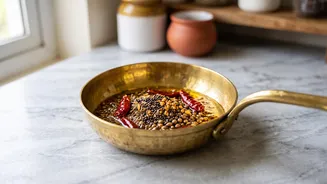
Tadka, also known as 'chaunk' or 'vaghar' in different regions, is a foundational technique in Indian cooking. It involves briefly frying whole or ground spices in hot oil or ghee to release their essential oils and aromatic compounds. This infused fat
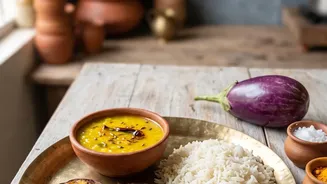
is then poured over a dish, either at the beginning to build a flavour base or at the end as a finishing touch. While it may seem like a simple step, it is a carefully orchestrated chemical reaction designed to extract, dissolve, and transform the flavour molecules within the spices. This process is what distinguishes a simple boiled lentil soup from a complex, aromatic dal, transforming the taste, aroma, and even the nutritional profile of the final dish.
The Science of Fat-Soluble Flavours
The magic of tadka lies in a basic principle of chemistry: many of the key compounds that give spices their characteristic aroma and flavour are fat-soluble, not water-soluble. This means they dissolve in fats like oil and ghee, but not in water. Compounds like cuminaldehyde in cumin, capsaicin in chillies, and eugenol in cloves remain trapped within the spice's tough cellular walls if added directly to a water-based curry or dal. Hot fat acts as a solvent, breaking down these cell walls and efficiently pulling out the trapped essential oils and flavour molecules. The infused fat then acts as a perfect carrier, distributing these complex flavours evenly throughout the entire dish, ensuring every bite is rich and fragrant.
Activating Phytonutrients for Health
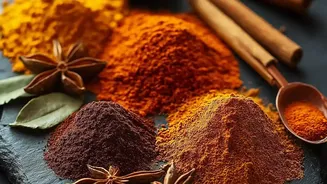
Beyond flavour, tempering is a powerful method for enhancing the nutritional benefits of spices. Spices are packed with phytonutrients—bioactive plant compounds with antioxidant and anti-inflammatory properties. One of the most famous examples is curcumin, the potent compound in turmeric. On its own, curcumin has very low bioavailability, meaning the body struggles to absorb it. However, because curcumin is fat-soluble, cooking it in hot fat dramatically increases its absorption. The combination of heat and fat makes these phytonutrients more available for your body to use. Ancient Ayurvedic wisdom, which has long celebrated spices for their medicinal properties, is validated by this modern scientific understanding.
The Crucial Role of Heat
Fat alone isn't enough; heat is the essential catalyst in this process. When spices are introduced to fat heated to the correct temperature, the heat works to rupture the spices' cellular structures, allowing the volatile oils to be released. This 'blooming' is what creates the instant, intense aroma that fills the kitchen. The high temperature also triggers browning reactions, such as the Maillard reaction, on the surface of the spices. This creates new, deeper, and more complex flavour notes that wouldn't exist in the raw spice. However, temperature control is key. Too little heat results in incomplete extraction, while too much will burn the spices, creating a bitter, acrid taste. The tell-tale popping of mustard seeds or the sizzle of cumin are auditory cues that the oil is at the perfect temperature for extraction.