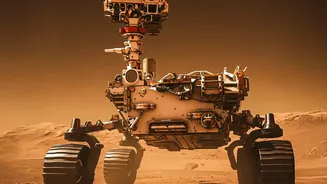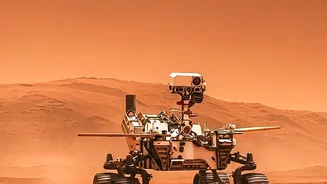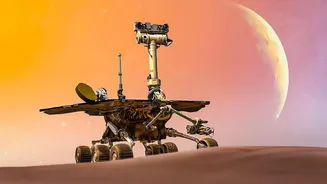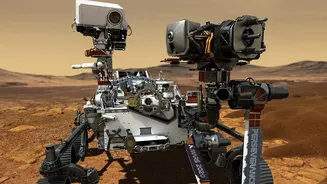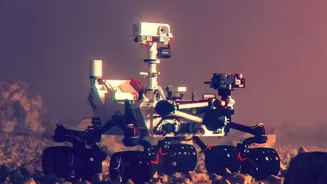







For years, NASA's Perseverance rover has been gathering priceless rock and soil on Mars. Getting those samples home is one of the greatest technical challenges in space exploration, and after hitting roadblocks, NASA is charting a new, leaner course.
A Treasure Hunt on the Red Planet
Since its landing in February 2021, the Perseverance rover has been diligently exploring Mars's Jezero Crater, a location believed to have once been a lake. Its primary mission is astrobiology: to search for signs of ancient microbial life. To do this, it's not just looking, but collecting. The rover is equipped with a sophisticated drilling system to capture core samples of rock and soil, seal them in ultra-clean tubes, and store them. Some tubes are kept inside the rover, while others have been strategically dropped at a depot location named 'Three Forks'. These samples represent a scientific jackpot, potentially holding the answer to whether life ever existed on Mars. Scientists believe studying them on Earth with advanced laboratory equipment could revolutionize our understanding of the Red Planet and our solar system.
Back to the Drawing Board
The original plan for retrieving these samples, a joint effort with the European Space Agency (ESA), was a highly complex, multi-stage campaign. It involved sending a large Sample Retrieval Lander to Mars, which would deploy a separate 'fetch rover' to collect the sample tubes. Those tubes would then be loaded onto a Mars Ascent Vehicle (MAV), launched into orbit, and captured by an Earth Return Orbiter for the long journey home. However, an independent review in 2023 raised serious concerns. The report flagged that the mission's complexity was driving the projected cost up to as much as $11 billion and pushing the sample return date to 2040. In April 2024, NASA Administrator Bill Nelson declared this timeline and price tag 'unacceptable', pausing the project and calling for a smarter, faster, and cheaper approach.
Introducing the PSRA Initiative
In response to this challenge, NASA announced a new initiative in November 2026: the Perseverance Sample Retrieval Architecture, or PSRA. This isn't a finalized mission design yet, but rather a strategic framework to develop one. Announced by Tiffany Morgan, the director of NASA's Mars Exploration Program, the PSRA's goal is to solicit and assess new, impartial recommendations for getting the job done. The core directive is clear: find a way to return the precious Martian samples more quickly and affordably than the previous plan allowed. A dedicated strategy team is set to kick off its work in January 2027, with the task of reviewing lessons learned, evaluating current capabilities, and delivering a final report with a recommended path forward in the winter of 2027-2028.
A Leaner Mission and a New Space Race
While the final architecture is yet to be decided, the call for new proposals has already generated innovative ideas from industry partners. One concept from Lockheed Martin, for example, suggests a simplified mission using a single, smaller lander based on the flight-proven InSight spacecraft design. This would reduce the overall mass and complexity, potentially cutting the cost significantly. Instead of a separate fetch rover, a revised plan might rely on the still-healthy Perseverance rover to deliver its onboard samples directly to the lander. The PSRA initiative is not just about budget and engineering, however. There's also a competitive element. China has announced its own ambitious Mars sample return mission, Tianwen-3, with a target launch around 2028 and a sample return date of 2031. This adds a sense of urgency to NASA's efforts, creating a modern-day space race to be the first to bring back pieces of the Red Planet.