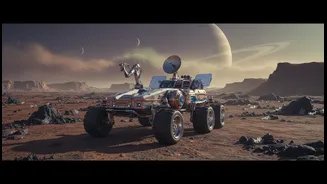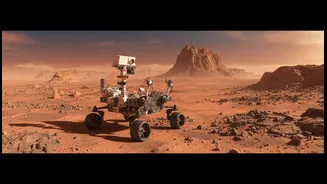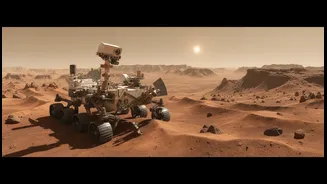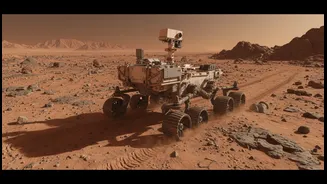






The Tyranny of Distance
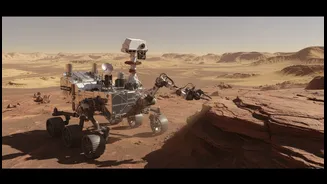
For decades, exploring Mars has been a slow and painstaking process. With an average communication delay of around 20 minutes each way, real-time control is impossible. Instead, mission planners at NASA's Jet Propulsion Laboratory (JPL) have had to act
as cautious choreographers. They meticulously analyze high-resolution orbital images and terrain data, plot a short, safe path with specific waypoints, and beam the instructions across millions of miles. The rover executes the commands and then waits for the next set of directions. This reliable but sluggish method severely limits how much ground a rover can cover in a single Martian day and demands immense effort from its human team on Earth. A particularly tricky boulder field could halt progress for days while engineers debated the safest way forward.
AI Takes the Driver's Seat
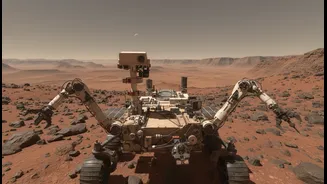
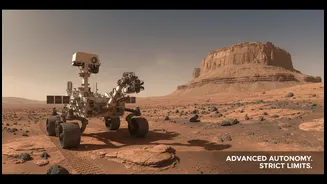
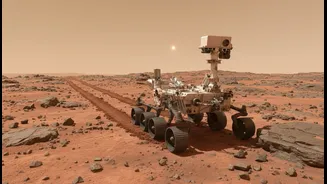
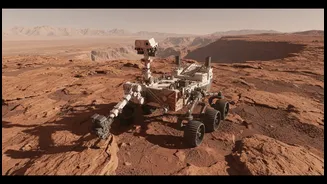
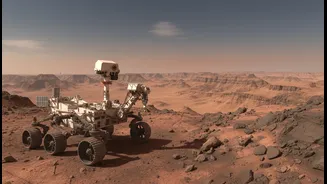
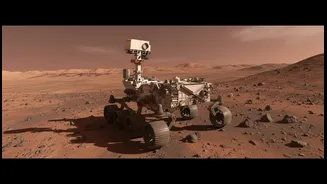
That is now changing, thanks to a groundbreaking demonstration on the Perseverance rover. In late 2025, for the first time ever on another planet, NASA handed over route-planning duties to a generative AI. In a collaboration with the AI company Anthropic, engineers used an advanced AI model to analyze the same complex data that human planners use. The AI assessed orbital imagery, identified hazards like large rocks and sand traps, and generated a safe and efficient route for the rover. After being rigorously tested in a 'digital twin' of Perseverance, the AI's plan was sent to Mars. On December 8 and 10, 2025, the rover successfully executed these AI-planned drives, covering hundreds of meters on its own initiative. This marked a pivotal moment, proving that AI can serve as a capable decision-support tool, freeing up human experts to focus on the bigger scientific picture.
A 'GPS' for the Red Planet
Planning a route is one thing, but knowing precisely where you are is another. Mars has no GPS network, which has been another barrier to true autonomy. To solve this, JPL engineers recently equipped Perseverance with a new technology called Mars Global Localization. This system acts like an onboard GPS by allowing the rover to figure out its exact position without human help. It works by rapidly comparing panoramic images from its own cameras with orbital terrain maps stored in its memory. The algorithm can pinpoint the rover’s location down to about 10 inches in just a couple of minutes. This ability to self-locate is a game-changer, as uncertainty about the rover’s position was a major factor limiting its autonomous driving speed and range. Now, the rover can navigate with greater confidence and cover longer distances between human check-ins.
Meet the Next-Generation Explorer
While Perseverance is getting smarter, its hardware has its limits. Looking to the future, NASA is already testing a next-generation prototype rover named ERNEST (Exploration Rover for Navigating Extreme Sloped Terrain). This compact rover is designed to go where no rover has gone before. Unlike its six-wheeled cousins, ERNEST has four wheels and an active suspension system that can lift each wheel individually, allowing it to climb over obstacles that would stop Perseverance in its tracks. More importantly, it is being trained using reinforcement learning, a type of AI where it learns by trial and error in complex virtual environments. This is teaching ERNEST to make its own sophisticated navigation decisions in real-time when faced with treacherous landscapes, preparing it for missions that require traveling hundreds or even thousands of miles across the Moon or Mars.