



The Cosmic Color Palette
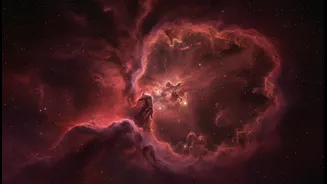
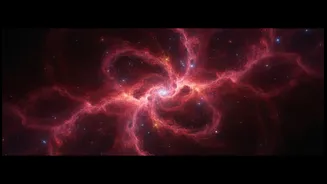
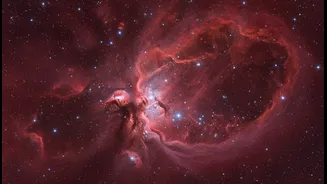
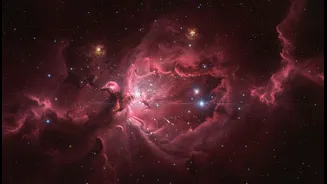
The deep red and crimson hues seen in many famous nebulae are not arbitrary. This distinct color is the signature of energized hydrogen gas. Hydrogen is the most abundant element in the universe, making up about 90% of most nebulae. When massive, young,
hot stars nearby unleash powerful ultraviolet radiation, they ionize the surrounding hydrogen atoms. As these atoms recapture their electrons, they emit light at specific wavelengths, the most prominent of which is a deep red light known as Hydrogen-alpha (H-alpha). This H-alpha emission is so strongly associated with these regions that astronomers use special filters to isolate this wavelength, revealing the intricate structures of the clouds and pinpointing areas of intense activity.
Stellar Nurseries in Action
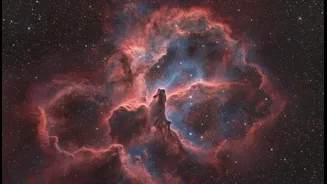
Many of these crimson clouds are, in fact, enormous stellar nurseries. They are turbulent regions where gas and dust are collapsing under gravity to form new stars. The powerful radiation from the most massive newborn stars illuminates the surrounding gas, creating the spectacular glowing vistas captured by telescopes like NASA's Hubble. A recent image of the LH 95 region in the Large Magellanic Cloud perfectly illustrates this, showing brilliant blue and white stars sparkling against a crimson backdrop. This specific glow is an excellent indicator for astronomers searching for star formation. LH 95, for instance, is home to an astonishing 2,500 young stars that are still gathering mass and have yet to begin nuclear fusion.
Sculpted by Stellar Winds
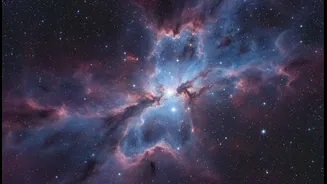
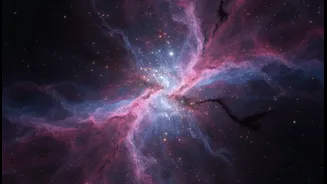
The relationship between the stars and the gas is not just one of illumination. The massive stars within these crimson clouds actively shape their environment. They unleash powerful stellar winds—streams of charged particles—that, along with intense radiation, carve out cavities, pillars, and other complex shapes in the surrounding gas. You can see this in the dense, dark filaments that often crisscross the glowing hydrogen. These are lanes of dust that are dense enough to resist the erosive forces of the stellar winds and radiation, creating a dramatic contrast against the brightly lit background. This process reveals a constant battle between the creative forces of star birth and the destructive power of their output.
Echoes of Dying Stars
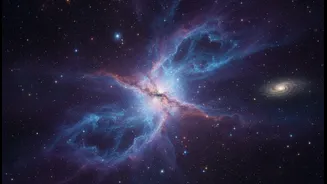
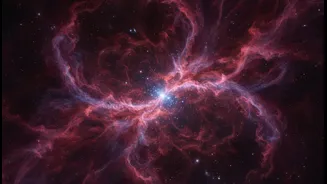
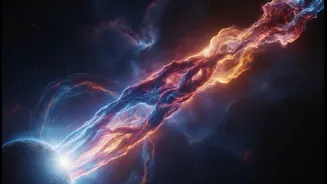
While many crimson clouds are birthing stars, others are the final, fleeting monuments to stars that have died. A supernova—the explosive death of a massive star—sends a tremendous shockwave hurtling through space. This shockwave slams into the interstellar medium (the sparse gas and dust between stars), heating it and causing it to glow. The resulting object, known as a supernova remnant, can also shine with the characteristic red of hydrogen, among other colors from different elements. The famous Crab Nebula is a prime example of a supernova remnant, an expanding cloud of debris from a star that was observed exploding in the year 1054. These remnants enrich the galaxy with heavy elements forged inside the star, providing the raw materials for future generations of stars and planets.