






The Trailblazer: Cassini’s Unprecedented Tour
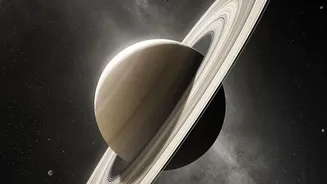
For 13 years, from 2004 to 2017, NASA's Cassini spacecraft was our dedicated eyes and ears in the Saturn system. It was a mission of unparalleled intimacy, orbiting the gas giant 294 times and revolutionizing our understanding of its rings and moons.
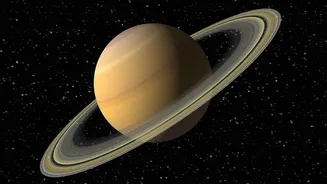
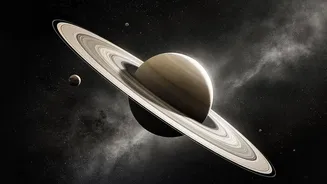
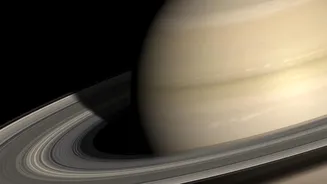
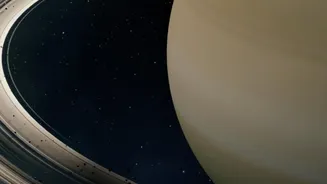
Before Cassini, the rings were seen as a relatively static, albeit beautiful, structure. Cassini revealed them to be an incredibly active and dynamic system. The spacecraft dove between the planet and its rings in its 'Grand Finale,' a feat that provided a trove of discoveries. It found that the rings are made almost entirely of water ice, with particles ranging from the size of a sand grain to that of a mountain. Cassini also discovered that some of Saturn’s tiny moons are actively shaped by ring material, scooping up particles to form strange, skirt-like equators. Most importantly, Cassini left scientists with profound new questions about the rings' age, origin, and the strange phenomena happening within them.
The Successor: Webb’s Powerful Infrared Gaze
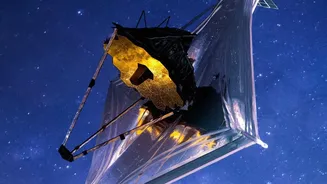
Enter the James Webb Space Telescope (JWST). Launched decades after Cassini, Webb is not a replacement but a powerful new partner. Where Cassini was an orbiter that got up close and personal, Webb is a distant observer with a very different skill set. It sees the universe in infrared light, allowing it to detect heat, peer through dust, and see faint structures that were invisible to other telescopes. When Webb turned its golden eye to Saturn in 2023, it provided a startlingly new perspective. At the infrared wavelengths Webb observes, Saturn's gaseous planet appears dark because methane in its atmosphere absorbs sunlight. However, the icy rings lack methane and shine brilliantly, creating an eerie, glowing portrait. This unique capability allows Webb to build upon Cassini's legacy, tackling the very mysteries that the earlier mission uncovered.
Mystery 1: The Enigmatic 'Spokes'
One of the most bizarre features of the rings are the 'spokes'—transient, ghost-like radial markings that appear and disappear with the seasons. First spotted by the Voyager spacecraft, Cassini provided the best close-up views of these phenomena during its mission. The leading theory is that the spokes are caused by an interaction between Saturn's magnetic field and the solar wind, which electrostatically levitates tiny dust and ice particles above the main rings. However, Cassini's mission ended before it could observe a full 'spoke season,' which peaks around Saturn's equinox. Now, as Saturn approaches its 2025 equinox, the spokes are back. Both Hubble and Webb are watching, providing a multi-wavelength view to finally confirm what causes these strange, fleeting features that can be larger than the diameter of Earth.
Mystery 2: The Age of the Rings
One of the most fundamental debates is about the age of the rings. Are they ancient relics formed with Saturn 4.5 billion years ago, or are they a relatively recent phenomenon, perhaps only 100 million years old, created by a shattered moon or comet? Cassini's data complicated the picture. Its final measurements showed that a constant rain of ring material is falling into Saturn's atmosphere, suggesting the rings are losing mass at a rate that would cause them to vanish in a geologically short time. This points to a younger age. However, some Cassini data also suggested the rings could be much older but are constantly being renewed. This is where Webb's expertise in chemical composition comes in. By analyzing the 'pollution' of the rings from interplanetary dust, Webb can help scientists determine how long the pristine ice has been exposed to the cosmic environment, providing a crucial new data point in this long-standing debate.
Mystery 3: The Giant, Ghostly Phoebe Ring
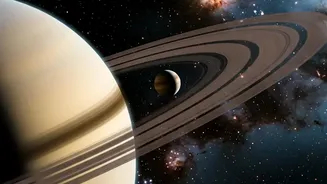
Perhaps the best example of the Cassini-Webb synergy is the story of Saturn's largest ring. The main rings are famous, but far beyond them lies the enormous, incredibly faint Phoebe ring. It is so vast it could hold a billion Earths and is sourced from dust kicked off the strange, dark moon Phoebe, which orbits Saturn backwards. The Spitzer Space Telescope first detected this behemoth, and Cassini's flyby of Phoebe confirmed the moon was a captured object from the outer solar system, coated in dark material. This dark dust spirals inward, slowly coating the forward-facing hemispheres of other moons like Iapetus, explaining its bizarre two-toned appearance. While Cassini could study Phoebe up close, the ring itself was too faint to image well. Webb, with its supreme sensitivity to infrared heat emitted by the dust particles, is perfectly suited to map this ghostly structure, helping scientists understand how this material moves through the Saturn system and influences its many worlds.