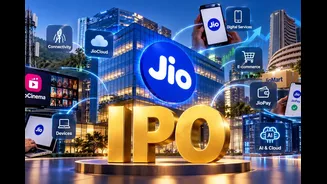







Jio Platforms has shattered records on Dalal Street. Its stock soared over 21% on its first day of trading, a blockbuster debut for what is now officially the largest public issue in India’s history. But what’s behind the investor frenzy?
A Blockbuster Debut on Dalal Street
On October 28,
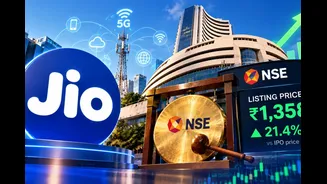
2026, Jio Platforms Ltd. made a stunning entrance onto the Indian stock exchanges. The shares, priced at ₹1,119 in the initial public offering (IPO), opened for trading at ₹1,358 on both the BSE and NSE. This marked a remarkable listing premium of 21.36%, a figure that delighted investors who had eagerly awaited the debut. The stock continued to climb, at one point touching ₹1,375, a gain of nearly 23% over its issue price. The massive interest translated into a market valuation that exceeded ₹12.5 lakh crore on its first day, instantly making Jio Platforms India's second-most valuable listed company.
India's Largest-Ever Public Issue
The successful listing was the culmination of India's biggest-ever IPO, which raised over ₹30,200 crore. The public issue, which ran from October 21 to October 23, rewrote the record books for investor participation. It became the first IPO globally to receive over one crore applications, with some reports putting the final number near 1.4 crore. The issue was oversubscribed more than 22 times, attracting total bids worth approximately ₹7.4 lakh crore when including demand from anchor investors. The sheer scale of the demand was unprecedented, with the issue being fully subscribed within just 100 minutes of opening, the fastest ever for a mega IPO in India.
What Drove the Investor Frenzy?
The overwhelming response wasn't just about hype; it was built on a solid foundation. Investors were drawn to Jio's dominant position in the Indian telecom market, where its subsidiary, Reliance Jio Infocomm, serves over 530 million subscribers. Beyond its massive user base, the company's compelling narrative as a diversified digital ecosystem proved irresistible. With ventures spanning cloud computing, enterprise solutions, home broadband, and AI, investors see a long runway for growth. The backing of global tech giants like Google and Meta, who are existing minority shareholders, also added a layer of confidence. Furthermore, analysts pointed to the company's improving financials, including a declining capital expenditure cycle and expectations of tariff hikes, which promise stronger free cash flow in the coming years.
The Ambani Strategy and Market Impact
The listing is a major victory for the value-unlocking strategy championed by Reliance Industries Chairman Mukesh Ambani. It marked the first public offering from the Reliance group in two decades, demonstrating a successful model of incubating a business to an enormous scale and then taking it public. Speaking at the listing ceremony, Akash Ambani, Chairman of Reliance Jio Infocomm, noted that the response 'surpassed our imagination' and marked the beginning of a new phase for the company. The success of the Jio IPO is also seen as a significant boost for the Indian capital markets, potentially encouraging other large Indian tech companies and unicorns to pursue public listings. It signals robust investor appetite for strong, scalable Indian growth stories, even in a complex global market.