





A Mysterious Birthplace
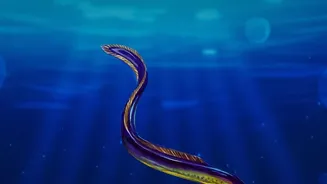
The life of every European eel begins in the Sargasso Sea, a unique region of the Atlantic Ocean defined not by land but by swirling currents. It was here, in the 1920s, that Danish scientist Johannes Schmidt first found the tiniest, leaf-shaped eel larvae,
known as leptocephali. This discovery confirmed that eels, which spend most of their lives in freshwater rivers across Europe, undertake an immense migration to this specific spot to spawn and die. The eggs hatch into these transparent larvae, only a few millimetres long, which are then faced with a monumental task: crossing an entire ocean to find a home they have never seen. For decades, scientists believed this journey was a passive drift, with the larvae simply being carried along by the powerful ocean currents like the Gulf Stream.
More Than Just Passive Drifters
While ocean currents certainly give the larvae a crucial push, mounting evidence suggests they are far from helpless passengers. Their journey can take between one and three years, and they undergo several transformations along the way. The idea that they could just randomly drift and successfully find river mouths thousands of kilometres away seemed improbable. American eels also spawn in the Sargasso Sea but reliably head west to North America, while European eels head east, suggesting an innate directional ability. This separation implies that the larvae must have some form of navigation to ensure they don't end up on the wrong continent. The question that has fascinated biologists for a century is: what is their guide?
An Internal Magnetic Compass
Recent research points to a fascinating answer: eels appear to navigate using the Earth's magnetic field. This ability, known as magnetoreception, is found in other long-distance migratory animals like birds and sea turtles. The theory is that eel larvae can sense variations in the planet's magnetic field, which differ depending on latitude and location. As they drift, they are thought to create a 'magnetic map', imprinting the magnetic signature of their migration path. This internal GPS would allow them to orient themselves and make active swimming choices, ensuring they stay on the correct course towards the European continent rather than drifting aimlessly. While the exact biological mechanism is still debated by scientists, the evidence strongly suggests these tiny creatures possess a sophisticated navigational toolkit.
Finding a Home
After their trans-oceanic journey, the larvae reach the continental shelf of Europe and metamorphose into 'glass eels', which are still transparent but now have the classic eel shape. From here, they must find their way into freshwater river systems. They use the tides to push themselves upstream into estuaries, where they begin to develop pigment and become 'elvers'. It is believed they may use other cues, such as the chemical signature of freshwater outflow, to home in on specific rivers. The larvae essentially go from navigating by a large-scale map (the magnetic field) to using local, sensory signposts to find a suitable habitat. They will then live in these rivers for anywhere from 5 to 20 years as 'yellow eels' before beginning their final transformation into 'silver eels' for the return journey to the Sargasso Sea to spawn.