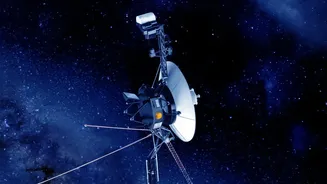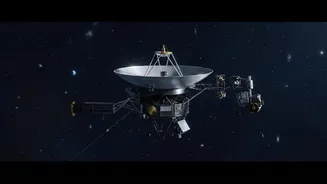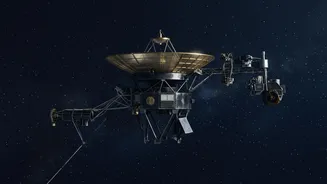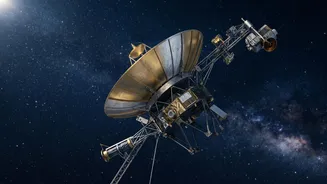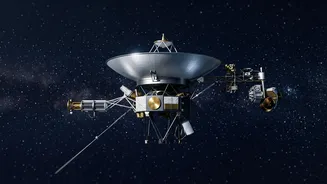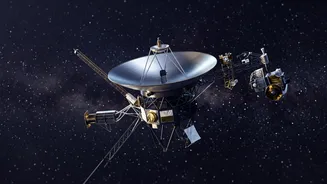



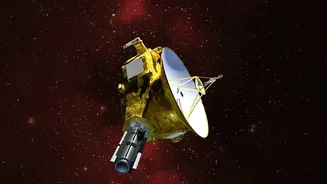
After 49 years spent speeding toward the void, humanity’s farthest messenger, Voyager 1, has given its mission team a scare and a surprise, restoring contact on its own after a 48-hour silence. This mysterious event comes just in time.
A Ghost in the Machine
In mid-October 2026,
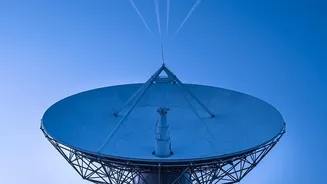
NASA’s Deep Space Network, a global array of giant antennas, listened for Voyager 1 during two scheduled contacts and heard nothing but silence. For about 48 hours between October 18 and 19, the probe, now nearly 26 billion kilometres away, was out of touch. Then, on October 20, before engineers could even send a troubleshooting command, Voyager 1’s signal reappeared. The probe had, it seems, fixed itself. An initial analysis suggests the spacecraft's fault protection system automatically switched from a main group of thrusters to a backup set, a programmed response to detecting a problem. This is the first time the spacecraft has been observed performing such a maneuver on its own, leaving engineers both relieved and eager to understand what triggered it.
A History of Long-Distance Repairs
This recent blackout was a new twist in a year of technical challenges. For seven months, from November 2023 to April 2024, the probe sent back streams of gibberish. The issue was traced to a single faulty memory chip in the Flight Data System (FDS), the computer that packages all science and engineering data for transmission. With no way to physically replace a chip that is billions of kilometres away, the JPL team devised an ingenious workaround. They sliced up the affected software code and carefully relocated the pieces into different, smaller spots in the FDS memory, a delicate operation on a 49-year-old computer with less than 70 kilobytes of memory. After sending the commands on April 18, 2024, the team had to wait 45 hours for the round-trip signal to confirm the fix had worked, successfully restoring the flow of usable data.
Crossing a Historic Threshold
This latest drama unfolds as Voyager 1 approaches a milestone of cosmic proportions. On November 18, 2026, the spacecraft will become the first human-made object to be one light-day away from Earth. A light-day, the distance light travels in 24 hours, is a staggering 25.9 billion kilometres. To put that in perspective, a radio signal traveling at the speed of light now needs a full 24 hours to reach the probe. A simple 'hello' sent from mission control will require a two-day wait for a reply. While no physical boundary will be crossed, this milestone marks the immense scale of Voyager’s journey and the profound communication delay that defines deep space exploration.
The Endurance of a 1970s Marvel
Launched in 1977 on a five year mission to study Jupiter and Saturn, Voyager $1$ has outlasted all expectations. Its longevity is a testament to its robust design and the creative problem solving of its mission team. The probe’s nuclear power source, however, is slowly fading, losing about four watts of power per year. This has forced engineers to make difficult choices, shutting down instruments and heaters over the decades to conserve energy. A recent power saving operation nicknamed the 'Big Bang' successfully rerouted power in September $2026$, a move expected to extend the life of the remaining science instruments for a few more years. With only two instruments still actively collecting data from interstellar space, every day of operation is a bonus, providing humanity's only direct sampling of the environment between the stars.