


A Day Longer Than a Year?
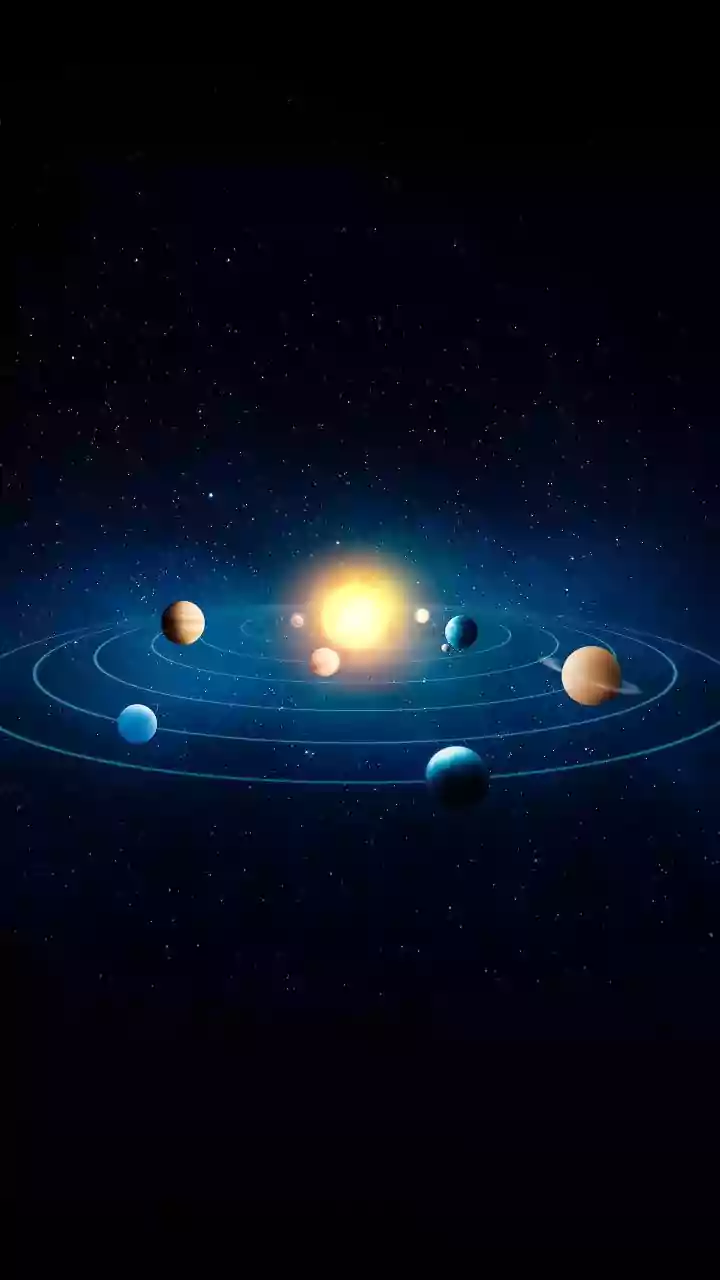
It sounds like a riddle, but it’s a straightforward astronomical fact. A ‘year’ is the time it takes a planet to complete one orbit around the Sun. For Venus, this journey takes about 225 Earth days. A ‘day’, however, is the time it takes a planet to rotate
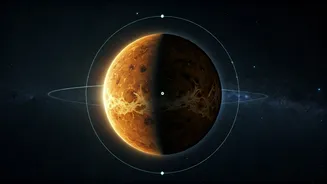
once on its axis. On this metric, Venus is the undisputed slacker of the solar system. It completes a single rotation in a staggering 243 Earth days. So, yes, a Venusian day is about 18 Earth days longer than a Venusian year. If you could stand on its surface, the Sun would rise and set, but the time between one sunrise and the next (a ‘solar day’) is different still—about 117 Earth days. This is because the planet is rotating while it also moves along in its orbit. The combination of its slow spin and its orbital motion creates this shorter sunrise-to-sunrise cycle. Still, you’d have to wait nearly four Earth months for the sun to appear again after it sets.
The Backward Planet
As if its lazy spin wasn't strange enough, Venus also rotates backwards. Nearly every planet in our solar system, including Earth, spins counter-clockwise on its axis. This is known as prograde rotation. Venus, however, spins clockwise—a motion called retrograde rotation. The only other major planet that does this is Uranus, which is tilted so far over it’s practically rolling on its side. This backward spin means that if you could somehow survive on the surface of Venus, you would see the Sun rise in the west and set in the east. This fundamental difference is a major clue that something dramatic and unusual happened in Venus's distant past. Planets don't just decide to spin the wrong way; they are forced into it by powerful cosmic events.
Why is Venus So Strange?
Scientists don't have a single, confirmed answer, but there are two leading theories that attempt to explain Venus’s bizarre rotation. The first, and most dramatic, is the “giant impact” hypothesis. This theory suggests that early in its history, Venus was struck by a massive object—perhaps a planet-sized body—that was large enough to not only slow its original rotation to a crawl but actually reverse it. Such a cataclysmic collision would have released an unimaginable amount of energy, forever altering the planet's destiny. A second, more gradual theory involves the planet's incredibly thick atmosphere. Venus's atmosphere is 90 times denser than Earth's and creates a runaway greenhouse effect, making it the hottest planet in the solar system. Some models suggest that powerful atmospheric tides, created by the Sun's immense gravity pulling on this dense blanket of gas, could have acted as a brake over billions of years. This friction between the solid planet and its heavy, churning atmosphere could have slowly bled away Venus's rotational speed and eventually flipped its spin.
A Truly Alien World
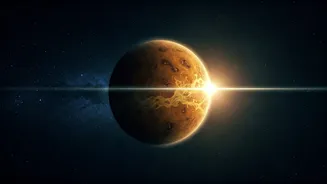
The long day-night cycle has profound consequences. The side of Venus facing the Sun bakes for months on end, while the night side is plunged into an equally long darkness. However, the planet's thick, carbon-dioxide-rich atmosphere is incredibly efficient at trapping and circulating heat. Winds whip around the planet at hundreds of kilometres per hour, ensuring that the night side remains scorchingly hot, with surface temperatures holding steady at around 465° Celsius—hot enough to melt lead. So, while the Sun may disappear for months, there is no cool relief. There is no water, only clouds of sulfuric acid. The atmospheric pressure on the surface is equivalent to being a kilometre deep in Earth's oceans. Venus is not just a planet with a long day; it’s a vision of a hellscape, a toxic and crushing environment where our concepts of time, weather, and life simply don't apply. Its strange rotation is just one feature of a world that is fundamentally alien to our own.