



Reading the Rainbow of Distant Worlds
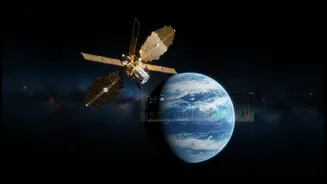
How do you find water on a planet hundreds of light-years away? The answer lies in starlight. When a planet passes in front of its star, a tiny fraction of the starlight filters through the planet’s atmosphere. Telescopes like the James Webb Space Telescope can
capture this light and spread it into a spectrum, like a rainbow. Different molecules in the atmosphere absorb light at specific, known wavelengths, leaving behind dark lines in the spectrum. When scientists see the tell-tale absorption pattern of water vapor, they know they have found a world with atmospheric moisture. This technique, called transit spectroscopy, has allowed astronomers to identify water on a growing list of exoplanets, from scorching hot gas giants to smaller, rocky worlds.
The Solar System's Primordial Recipe
To understand why distant water matters for our own history, we have to rewind about 4.6 billion years. Before the planets, our sun was surrounded by a massive, rotating disc of gas and dust called a protoplanetary disk. This disk was the cosmic kitchen where all the ingredients for the planets were stored. The chemical composition of this disk—the specific mix of elements and molecules—determined the recipe for every planet, moon, and asteroid that would eventually form. Scientists have long theorized that the materials in this disk were not uniform; it was hotter near the young sun and colder farther out, creating distinct chemical zones.
Water's Isotopic Fingerprint
Not all water is created equal. The water molecule, H₂O, can contain different versions, or isotopes, of hydrogen. The most common is standard hydrogen (protium), but a heavier version called deuterium also exists. The ratio of heavy water (containing deuterium) to normal water is like a chemical fingerprint, and it can tell scientists a lot about where and how that water formed. Water in the cold outer regions of a protoplanetary disk is expected to have a different isotopic ratio than water formed in the warmer inner regions. By measuring these ratios in comets, asteroids, and even on Earth, scientists have pieced together a story of how our planet got its oceans, largely pointing to delivery by icy bodies from the outer solar system.
Universal Building Blocks
This is where exoplanets come in. When astronomers detect water in the atmosphere of a planet in another solar system, they are not just finding H₂O; they are sampling the end product of another planetary formation process. If the water on these diverse and distant worlds shows similar isotopic patterns to the water in our own solar system, it suggests something profound: that the chemical processes governing the formation and distribution of water are universal. It implies that the raw materials and the mechanisms for creating water-rich planets are common throughout the galaxy. This reinforces the idea that the way our solar system formed was not a fluke, but a standard model for planetary construction.
A New Perspective on 'Home'
The study of atmospheric moisture on exoplanets is therefore a study of our own origins. It tests our most fundamental theories about how a barren, rocky Earth became the blue marble we know today. Some recent theories even suggest that planets can create their own water through chemical reactions between hydrogen-rich atmospheres and magma oceans, complicating the traditional picture of delivery by comets. Observing exoplanets provides a crucial laboratory to test these competing ideas. It allows us to see which planetary formation scenarios play out in reality, not just in computer models. Finding water elsewhere isn't just about the possibility of alien life; it is about confirming the chemical story that led to our own existence.