







What Exactly Is a Skyrmion?
First proposed in the 1960s by physicist Tony Skyrme, a skyrmion is a stable, particle-like knot in a continuous field. Initially a concept in particle physics, the idea found new life in the world of magnetic materials. Imagine a material where all the microscopic
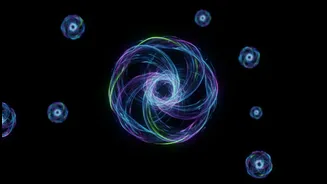
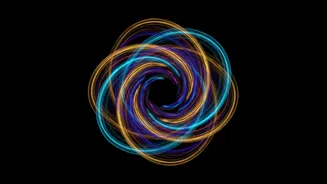
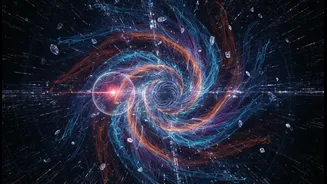
magnetic poles are aligned, like a perfectly combed field of grass. A magnetic skyrmion is like a tiny, self-contained whirlwind within that field, where the magnetic moments swirl into a stable, topological knot. The key word is 'topological'. This means the knot is incredibly robust; you can't easily undo it without cutting it. This stability makes it a fantastic candidate for storing data, where the presence of a skyrmion could represent a '1' and its absence a '0'.
Making the Leap from Magnetism to Light
While magnetic skyrmions are promising, the real cutting-edge excitement has shifted to creating these structures not with magnetic fields, but with light itself. An optical skyrmion is a topological knot made from the properties of light, such as its polarisation and phase. Think of it as sculpting light into a persistent, nanoscale pattern that doesn't easily dissipate. Early methods to create these light-based whirlwinds were complex, often requiring expensive, artificially engineered metamaterials to manipulate light in just the right way. However, recent breakthroughs have shown that it's possible to generate them much more simply. In a remarkable development, scientists at Nanyang Technological University in Singapore revived a 200-year-old experiment, using the light that bends around a tiny circular object to naturally produce stable optical skyrmions. This makes the phenomenon far more accessible for study and experimentation.
The Promise for Future Computers
The potential applications of optical skyrmions are vast, touching on nearly every aspect of next-generation technology. For data storage, their tiny size and stability could lead to ultra-high-density devices far beyond current capabilities. They could be used in 'racetrack memory', where information is encoded in a chain of skyrmions moved at high speed with low energy cost, a significant improvement over the mechanical parts in today's hard drives. In computing, they could form the basis of all-optical logic gates or even unconventional computing paradigms like Brownian computing, which uses the natural, random motion of particles to solve complex problems efficiently. Furthermore, their inherent stability makes them ideal candidates for qubits in quantum computers, potentially overcoming the massive challenge of quantum states collapsing at the slightest disturbance. This robustness could also lead to more secure quantum communication.
Hurdles on the Horizon
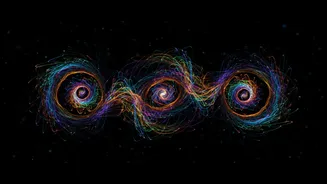
Despite the immense promise, skyrmion-based technology is still in its early days, with significant challenges to overcome before it appears in consumer devices. For one, most of the work is still happening in controlled laboratory settings. Creating, controlling, and reading these tiny structures reliably and at scale is a major engineering hurdle. While new methods are making skyrmions easier to generate, integrating them into scalable solid-state devices remains a formidable task. For quantum applications, a deeper understanding of their quantum behaviour, such as the tunneling between states, is needed. Scientists are still largely in the fundamental discovery phase, experimenting with different ways to create and manipulate these light patterns, such as forming 'skyrmion bags' by overlapping light fields on gold surfaces. The transition from fascinating physics to applied engineering will require years of further research and development.