




Why Sound Needs a Ride
Think of sound as a wave of dominos. When you speak, your vocal cords vibrate, pushing air molecules, which push the next ones, and so on, until that wave of vibrating molecules hits someone’s eardrum. Sound is, at its core, a mechanical wave—a vibration
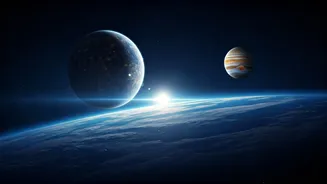
traveling through a medium. It needs something to travel *through*, whether it’s the air in a room, the water in a pool, or the metal of a railroad track. The problem with space is that it’s an almost perfect vacuum. There’s no significant atmosphere, meaning there are virtually no particles for sound waves to push against. The average particle density in interstellar space is about one atom per cubic centimeter. For comparison, the air we breathe has about 25,000,000,000,000,000,000 molecules in that same space. Without a medium to carry the vibrations, sound simply cannot exist. An explosion could detonate a star, but the resulting shockwave of energy would be utterly silent to our ears.
The Exception: Life in a Bubble
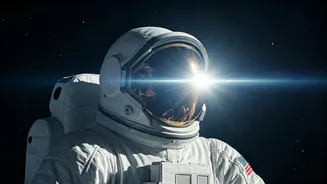
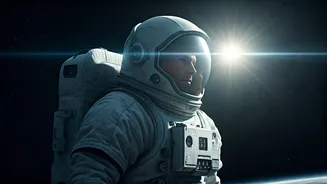
So, are astronauts floating in total silence? Not at all. This is where the famous tagline from the movie *Alien*—“In space, no one can hear you scream”—is a little misleading. While no one *outside* your helmet or ship could hear you, your crewmates certainly could. Astronauts live and work inside pressurized environments like the International Space Station (ISS) or their spacesuits, which are filled with a breathable atmosphere. Inside that bubble, sound behaves just as it does on Earth. Astronauts can hear the hum of life-support systems, the crackle of the radio, the whir of fans, conversations with mission control, and, yes, a fellow astronaut’s scream. Sound travels perfectly well through the air in their helmets and the metal structure of the station. The silence is only on the other side of the glass.
Hearing the Unhearable
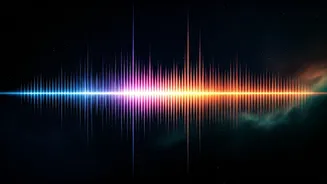
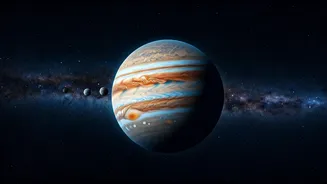
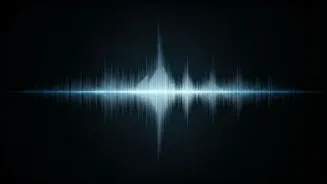
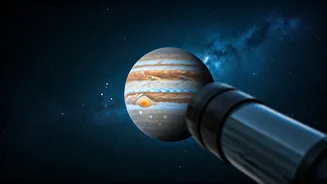
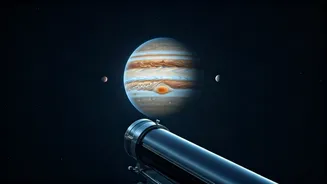
While space is audibly silent, it’s not quiet. The cosmos is filled with a cacophony of electromagnetic waves—radio waves, X-rays, and visible light—as well as gravitational waves, which are ripples in spacetime itself. None of these are sound waves, but scientists can translate them into sounds our ears can understand in a process called data sonification. By assigning pitches and tones to different frequencies or intensities of light or energy, they create an audible representation of cosmic events. Thanks to sonification, we can “hear” the haunting whistle of plasma waves interacting with Jupiter’s magnetic field, the rhythmic pulse of a spinning pulsar, or the cataclysmic “chirp” of two black holes merging a billion light-years away. These aren’t the actual sounds of space, but they are an authentic translation of its data, giving us a powerful new way to experience and analyze the universe. It turns silent data into something deeply intuitive and often beautiful.
Vibrations in the Void
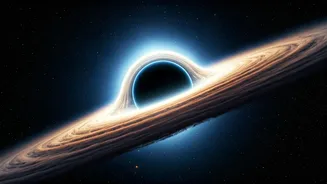
While the vacuum of space itself can’t carry sound, some cosmic structures aren’t perfect vacuums. Giant clouds of gas and plasma, known as nebulae, are dense enough to carry pressure waves that are, technically, sound waves. In 2003, NASA's Chandra X-ray Observatory detected pressure waves rippling through the Perseus galaxy cluster, generated by a supermassive black hole. The pitch was calculated to be a B-flat, but it was 57 octaves below middle C—a frequency so low it would take 10 million years to complete a single oscillation, making it utterly inaudible to humans. So, while sound waves *do* exist in some parts of space, they are on a scale so grand and slow that they are fundamentally alien to our sense of hearing.