




The Junkyard Above Our Heads
For decades, we have been launching rockets and satellites into orbit. While these technologies have connected our world in unprecedented ways, they have also left a dangerous legacy: space debris. Millions of pieces of junk, from defunct satellites and spent
rocket stages to tiny flecks of paint, are currently circling the Earth at incredible speeds. Even a fragment smaller than a cherry can strike with the force of a hand grenade, capable of disabling or destroying a multi-million dollar satellite. This orbital junkyard poses a significant threat to the active satellites we depend on for everything from GPS navigation and weather forecasting to internet connectivity and financial transactions. The problem is only getting worse as more and more satellites are launched.
Enter the Debris Hunters
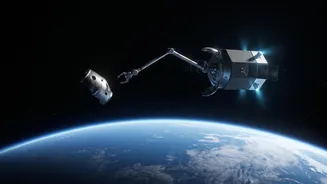
To combat this growing threat, space agencies and private companies are developing a range of Active Debris Removal (ADR) technologies. Think of them as cosmic garbage collectors, designed to seek out, capture, and safely remove the most dangerous pieces of junk. Several innovative methods are being tested, including robotic arms, large nets, and, most compellingly, concepts involving lasers and harpoons. Companies like Astroscale and ClearSpace, in collaboration with agencies like the European Space Agency (ESA), are pioneering missions to demonstrate that cleaning up orbit is not just possible, but essential for a sustainable future in space.
The Laser: A Gentle Nudge
One of the most promising technologies involves using powerful lasers, which can be based either on the ground or on a satellite. A space-based laser would not vaporize the debris as in a movie. Instead, it uses a technique called 'laser ablation'. The laser fires a concentrated beam of light at a piece of debris, heating a tiny spot on its surface until it turns into a jet of plasma. This small burst acts like a tiny rocket thruster, giving the object a gentle but precise push. By carefully targeting these nudges, operators can alter the debris's trajectory, guiding it into a lower orbit where it will eventually enter and burn up in Earth's atmosphere. This no-contact method is ideal for dealing with the millions of smaller but still dangerous fragments.
The Harpoon: A Decisive Snag
For larger and more unwieldy objects like old satellites or rocket bodies, a more direct approach may be needed. Enter the space harpoon. Missions like RemoveDEBRIS, supported by Airbus and the University of Surrey, have already successfully tested firing a harpoon at a target plate in orbit. The concept is straightforward: a 'chaser' spacecraft approaches a piece of tumbling debris, fires a tethered harpoon into it, and secures a connection. Once attached, the chaser can control the captured object, either dragging it into a decaying orbit to burn up or moving it to a less populated 'graveyard' orbit. This ancient technology, once used for whaling, is being adapted as a robust and effective tool for cleaning our cosmic seas.
Protecting Our Connected Future
The development of these technologies is not just an academic exercise; it's a critical business necessity. The cost of protecting current satellites from debris already amounts to a significant percentage of total mission costs, and the economic impact of inaction could be enormous. The World Economic Forum has projected that orbital congestion could cost the industry billions over the next decade from service interruptions and avoidance maneuvers. By actively removing debris, we protect not only individual satellites but the entire interconnected infrastructure that supports our global economy. Clearing key orbits ensures that services like telecommunications, Earth observation, and global navigation systems remain reliable and secure for generations to come.