





India's Ambitious Voyage to Shukra
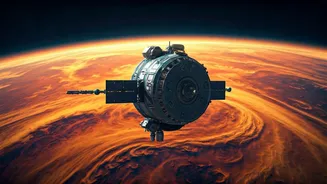
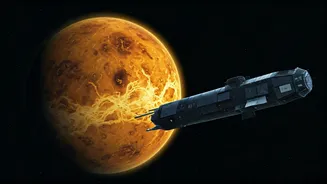
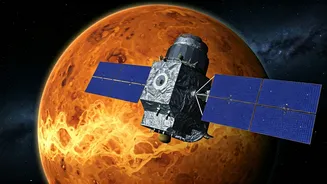
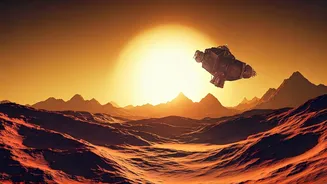
The Indian Space Research Organisation (ISRO) is planning its first-ever mission to Venus, named Shukrayaan-1. Officially called the Venus Orbiter Mission (VOM), this landmark project, approved in September 2024, is slated for a launch in March 2028.
After the successes of Chandrayaan (Moon) and Mangalyaan (Mars), Shukrayaan represents India's next great leap into interplanetary science. The mission aims to send an orbiter equipped with a suite of advanced instruments to study Venus from above, peeling back the layers of its thick, sulfuric acid clouds to understand its surface, geology, and atmospheric dynamics. Key objectives include mapping the surface and sub-surface, analysing the complex chemistry of its atmosphere, and studying the interaction between the planet and the solar wind.
A Portrait of a Runaway Greenhouse
To understand why a mission to Venus is so relevant, we must first understand Venus itself. Despite being similar to Earth in size and mass, its conditions could not be more different. The planet suffers from a catastrophic, runaway greenhouse effect. Its atmosphere is over 90 times denser than Earth's and is composed of more than 96% carbon dioxide, a potent greenhouse gas. This toxic blanket traps heat so effectively that surface temperatures average a staggering 475 degrees Celsius, making it the hottest planet in the solar system. Scientists believe that early in its history, Venus may have had oceans and a climate similar to Earth's. However, a massive release of greenhouse gases, possibly from intense volcanic activity, triggered a positive feedback loop: rising temperatures boiled the oceans, putting more water vapour (another greenhouse gas) into the atmosphere, which trapped even more heat, until the planet became the inhospitable world it is today.
Earth's Ghost of Christmas Future?
The story of Venus serves as a stark planetary-scale cautionary tale. While Earth is not on the verge of becoming Venus tomorrow, studying its climate history provides a natural laboratory for understanding the extreme consequences of an unchecked greenhouse effect. On Earth, most of our planet's carbon is locked away in rocks and oceans. On Venus, nearly all of it is in the atmosphere. By studying how Venus lost its oceans and transformed from a potentially habitable world into a furnace, scientists can refine their climate models for Earth. ISRO’s Shukrayaan, along with missions from NASA and ESA, will investigate Venus’s atmospheric composition, cloud dynamics, and volcanic history. This data is crucial for understanding the tipping points in a planet's climate system and validating our predictions for global warming here at home.
The Science of Survival
The instruments aboard Shukrayaan-1 are specifically designed to answer these critical questions. A high-resolution Synthetic Aperture Radar (SAR) will map the planet’s surface, piercing through the dense clouds to give us a clear picture of its geology and look for signs of active volcanoes. A ground-penetrating radar, a first for Venus, will investigate the shallow sub-surface. Other instruments will analyse the chemical makeup of the atmosphere, measuring gases like carbon dioxide and sulfur dioxide, which plays a key role in the formation of its acid clouds. By studying these processes in an extreme environment, we gain invaluable insights. For instance, understanding how Venus's atmosphere circulates and retains heat can help us better comprehend atmospheric physics under high-CO2 conditions, making our own climate change projections more robust.