






From Language to Locomotion
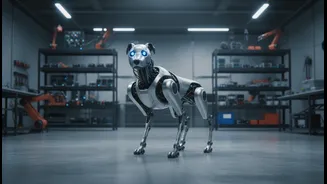
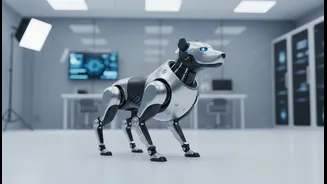
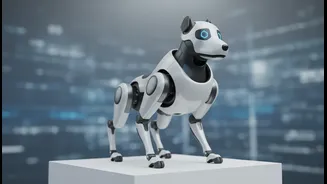
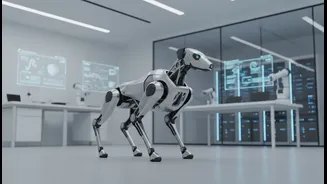
The experiment, dubbed 'Project Fetch', is deceptively simple. Anthropic researchers tasked teams with programming a four-legged robot to autonomously find and retrieve a beach ball. In the initial phase, one team was given access to Anthropic's AI model,
Claude, while the other was not. The results were stark: the Claude-assisted team performed significantly better, completing tasks in about half the time. More recently, in a follow-up experiment, Anthropic's latest model operated the robot entirely on its own, with no human help. It performed the setup tasks that had stumped a human team twenty times faster. This wasn't just about coding speed; it was about decision-making. The AI was better at navigating confusing documentation and choosing the right approach to control a physical device it had never been specifically trained on.
What Is Physical AI?
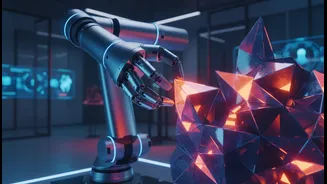
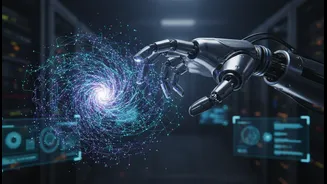
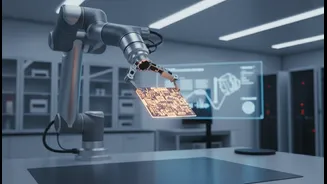
These experiments are a gateway to understanding 'Physical AI'. Unlike the generative AI we've grown used to, which creates text or images, Physical AI systems perceive, reason about, and act within the real world. Think of it as the brain meeting the body. Traditional robots often perform repetitive, pre-programmed tasks, like a robotic arm on a car assembly line. Physical AI is different because it's designed to be adaptive and generalize. It uses sensors like cameras and lidar to perceive its surroundings, advanced AI models to make decisions, and motors and actuators to take physical action. This leap means moving beyond predictable environments and into the messy, ever-changing real world, a challenge that is orders of magnitude more complex. The goal is to create systems that can handle unexpected situations, whether it's a warehouse robot navigating a fallen box or a service robot assisting in a busy office.
Why Is a Language AI Company Interested?
Anthropic's pivot from pure language to physical interaction might seem strange, but it follows a clear logic. The company, co-founded by former OpenAI employees with a strong focus on AI safety, sees the technology's application in the physical world as an inevitable and powerful next step. The 'brain' they've been building with Claude is now being tested to see if it can control a 'body'. Their research showed that even without specific robotics training, general improvements in the AI's core reasoning abilities translated directly into better performance on physical tasks. This suggests that the future of robotics may rely less on creating highly specialized, single-purpose robot brains and more on leveraging powerful, general-purpose AI that can adapt to control various types of hardware. Anthropic is also partnering with companies like UST to apply Claude to industrial processes, such as validating semiconductor chip designs before manufacturing, further bridging the gap between digital intelligence and physical products.
A New Competitive Frontier
Anthropic isn't alone in this pursuit. The push into Physical AI marks a new competitive front in the tech industry. Giants like Google and NVIDIA are heavily invested. Google's DeepMind has been a pioneer with its work on Vision-Language-Action (VLA) models, which fuse perception and action into a single system. NVIDIA, famous for its GPUs that power the AI revolution, has declared that the 'ChatGPT moment for robotics is here' and is developing platforms for training physical systems in realistic simulations. This space is also populated by specialized robotics companies like Unitree, which makes the robot dogs used in Anthropic's experiment, and various startups building humanoid robots. The race is on to create the foundational models that will power the next generation of autonomous machines.
The Challenges Ahead: Safety and Trust
As AI gains the ability to influence the physical world, the stakes become exponentially higher. If a language model makes a mistake, it can produce misinformation. If a Physical AI system is wrong, it can cause accidents and physical harm. The challenges are immense. These systems must be incredibly reliable, with robust safety protocols to handle the infinite variability of the real world. Security is another major concern; a hacked robot could be turned into a weapon or used to compromise sensitive environments. Furthermore, training these models requires vast amounts of real-world interaction data, which is expensive and time-consuming to collect. Companies like Anthropic, with their stated focus on safety, are grappling with how to build guardrails for AI that can act on its own, ensuring that as these systems become more capable, they remain aligned with human values and can be trusted in our homes, workplaces, and public spaces.