



A Star’s Life and Death
Most stars, including our own Sun, don't last forever. They spend about 90% of their lives in a stable phase called the main sequence, fusing hydrogen into helium. But when the hydrogen fuel starts to run low, the star enters its dramatic final chapters.
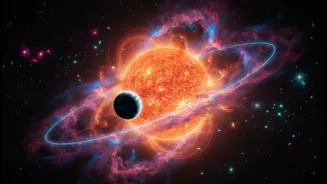
For a star like the Sun, this means swelling into an enormous, luminous red giant. This expansion is so vast it can engulf the nearest planets. After this phase, the star sheds its outer layers into space, leaving behind a dense, Earth-sized core called a white dwarf, which slowly cools over billions of years.
The Shifting Gravitational Dance
When a star expands into a red giant, it ejects a significant portion of its mass in the form of powerful stellar winds. According to the fundamental laws of gravity, a star's gravitational pull is directly related to its mass. As the star loses mass, its gravitational grip on its surviving planets weakens. This causes the planets' orbits to change, typically migrating outwards to wider, more distant paths. This is a crucial first clue. The orbital distance of a planet around an old, dead star isn't necessarily where it spent most of its life. It's a clue to the chaos it has endured.
Reading the Orbital Clues
Scientists can now piece together this history by studying planets around white dwarfs. A key insight is that a planet's journey is not just affected by its star's mass loss, but also by interactions with other surviving planets or even passing stars. A system that was once stable can become a chaotic pinball machine after the star’s transformation. Planets can be thrown into highly eccentric, or non-circular, orbits. By observing a planet's current orbit around a white dwarf, astronomers can run models backward in time. They can calculate the orbital changes and infer how much mass the original star lost, and how violently the system was disrupted.
A Window Into Violent Pasts
These orbital signatures are a new tool for cosmic archaeology. For example, recent observations with the James Webb Space Telescope of a planet named WD1856b revealed its dramatic history. The planet is much hotter than it should be, suggesting it migrated inward long after its star had died, likely due to gravitational nudges from other stars in its system. By analyzing the atmospheres of white dwarfs, scientists can also find evidence of them 'polluting' themselves by consuming the debris of shattered asteroids and planets, another testament to a chaotic past. Each polluted white dwarf is a crime scene, and the orbits of any surviving planets are the witness testimonies.
The Future of Our Own Solar System
This line of research naturally leads to a question closer to home: What will happen to Earth? In about five billion years, the Sun will begin its red giant phase. Models predict it will expand to at least the orbit of Earth, vaporizing Mercury and Venus in the process. There's a chance Earth might be pushed into a wider, safer orbit as the Sun loses mass, but it’s also possible it will be engulfed entirely. Even if Earth survives, the surviving outer planets, like Jupiter and Saturn, may have their orbits thrown into disarray, creating a very different-looking solar system around our Sun's future white dwarf core. The study of distant planetary systems provides a preview of our own cosmic destiny.