







A Close Shave with the Red Planet
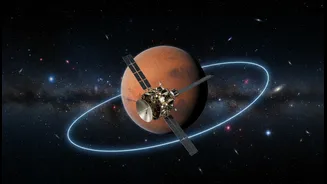
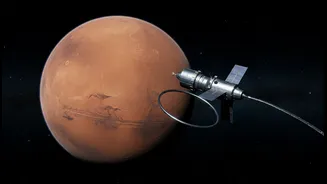
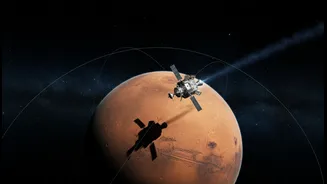
On May 15, 2026, NASA’s Psyche spacecraft dipped into the gravity well of Mars, skimming just 2,864 miles above its rust-coloured surface. This wasn't a sightseeing trip. It was a meticulously planned manoeuvre known as a gravity assist, a kind of cosmic
slingshot. For a mission traversing billions of kilometres, every drop of fuel is precious. Psyche relies on ultra-efficient solar electric propulsion, which provides a gentle, constant push by firing out charged xenon ions. While incredibly efficient over time, this system doesn't provide the raw power needed for major course corrections. By letting Mars do the heavy lifting, the spacecraft gained a significant speed increase without burning any of its own propellant, a huge win for the mission's long journey ahead.
The Science of a Cosmic Slingshot
So, how do you steal speed from a planet? It might sound like it defies physics, but it's all about momentum. Think of it like a professional tennis player hitting a fast-moving ball. The player's swing (the planet's gravity) and the ball's existing speed combine to send it flying off the racket much faster than before. If Mars were standing still, Psyche would have sped up as it approached and slowed down by the same amount as it flew away, resulting in no net gain. But Mars is hurtling around the Sun at thousands of miles per hour. By swinging in behind the moving planet, Psyche was able to borrow a tiny, insignificant fraction of Mars's enormous orbital momentum and add it to its own speed. The official analysis confirmed the flyby gave Psyche a 1,000-mph boost, a 'free' acceleration that sets it on the perfect path for its final destination.
More Than Just a Speed Boost
While the speed increase grabs headlines, the gravity assist was just as critical for another reason: changing the spacecraft's trajectory. The asteroid Psyche orbits the Sun on a different plane than Earth and Mars. Getting from our plane to its plane is a major navigational challenge. The Mars flyby tilted Psyche's orbit by about one degree—a seemingly tiny adjustment that was absolutely essential to line up its path for an eventual rendezvous with the asteroid in August 2029. Without this gravitational nudge from Mars, the mission simply couldn't get to its target. The flyby also served as a valuable dress rehearsal, allowing the mission team to power up and calibrate Psyche's science instruments by taking some unique pictures of Mars.
Destination: A Mysterious Metal World
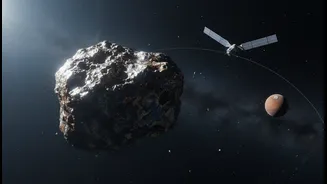
The entire point of this epic journey is to study a one-of-a-kind object in our solar system: the asteroid 16 Psyche. Located in the main asteroid belt between Mars and Jupiter, this massive, potato-shaped body is thought to be the exposed nickel-iron core of an ancient protoplanet—a building block of a world that was smashed apart by collisions billions of years ago. While we know that rocky planets like Earth have metallic cores, they are buried deep beneath miles of rock and are impossible to study directly. Psyche offers a unique opportunity to see one of these planetary cores up close for the first time. Scientists hope that by studying its geology, composition, and magnetic field, we can unlock secrets about how planets form and evolve.
The Long Road Ahead
With the Mars flyby successfully completed, the Psyche spacecraft now begins the longest, quietest phase of its journey. For the next three years, it will cruise through the outer solar system, its solar-electric engines firing almost continuously. It will cover hundreds of millions of more miles before it can finally begin its approach sequence in 2029. When it arrives, it won’t be a fleeting flyby. Psyche will spend 21 months in orbit around the asteroid, methodically mapping and studying its surface from a series of different altitudes to build a complete picture of this strange new world. For scientists back on Earth, the wait will be long, but the potential discoveries about the origins of our own planet are worth it.