


An Asteroid's Identity Crisis
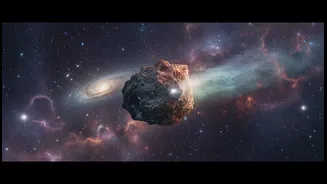
In the main asteroid belt, a region of space between Mars and Jupiter, hundreds of thousands of space rocks orbit the Sun. For years, an object known as (248370) 2005 QN173 was just one of them—a quiet, unassuming asteroid. But recently, astronomers using
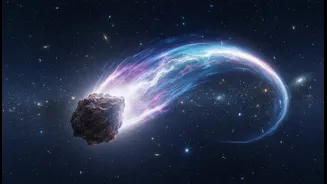
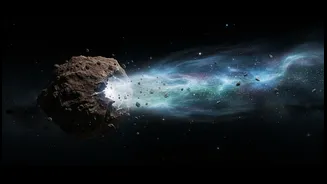
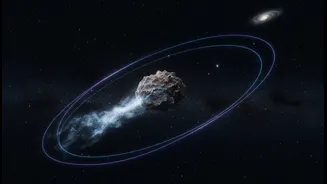
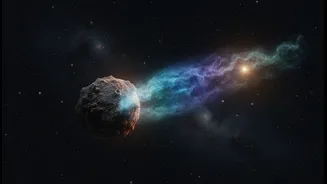
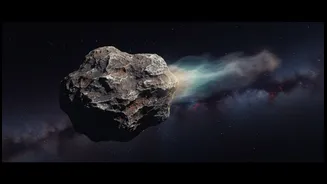
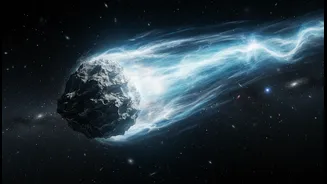
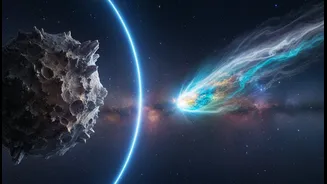
the Asteroid Terrestrial-impact Last Alert System (ATLAS) survey noticed something extraordinary. This supposedly inactive rock had sprouted a magnificent, comet-like tail stretching over 720,000 kilometres. It was a startling development that challenged the fundamental definitions that have guided astronomy for centuries. This wasn't just an asteroid anymore; it had become an 'active asteroid', a member of a rare and puzzling class of celestial objects that behave like both asteroids and comets.
The Old Rules: Asteroid vs. Comet
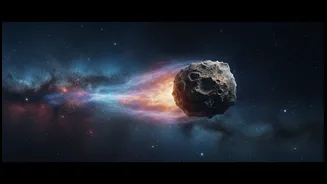
Traditionally, the distinction has been simple. Comets are often called 'dirty snowballs' and originate from the frigid outer reaches of the solar system, like the Kuiper Belt beyond Neptune or the even more distant Oort Cloud. When their long, elliptical orbits bring them closer to the Sun, the heat causes their ice to sublimate—turn directly from a solid to a gas. This process releases dust and gas, creating the beautiful coma (a fuzzy atmosphere) and a characteristic tail that always points away from the Sun. Asteroids, on the other hand, are thought to be rocky and metallic remnants from the solar system's formation. They reside primarily in the warmer inner solar system in the main asteroid belt and, lacking significant ice, were believed to be inert and unchanging. They were the silent, rocky neighbours to the dramatic, showy comets.
Meet the Active Asteroids
The discovery of activity on 2005 QN173 places it in a special category now known as 'active asteroids' or 'main-belt comets'. These are objects with the orbit of an asteroid but the physical appearance of a comet. This isn't the first of its kind—fewer than 30 are currently known—but it is a particularly striking example. Scientists have since looked back at archival images and found that this asteroid showed a similar tail during its previous close approach to the sun in 2016. This recurring activity strongly suggests that the tail isn't the result of a random collision with another rock but is driven by the sublimation of ice, just like a true comet. It implies that despite residing in the relatively warm asteroid belt for aeons, pockets of ancient ice have somehow survived, buried beneath its surface.
Why This Changes Everything
The existence of these hybrid objects has profound implications. For one, it could help solve the mystery of where Earth's water came from. The chemical signature of water in many classical comets doesn't quite match Earth's oceans. However, if asteroids in our own cosmic neighbourhood hold water ice, they become prime suspects for delivering this life-giving ingredient to a young, hot Earth billions of years ago. Studying these active asteroids allows scientists to sample the composition of the inner solar system and understand how water and other volatile materials were distributed during its formation. It suggests that the line between a dry, rocky world and an icy, wet one is not as clear-cut as once believed. These objects are essentially time capsules from the birth of our planetary system.
The Search for More Cosmic Chameleons
Discoveries like this have spurred a dedicated search for more active asteroids. Modern sky surveys like ATLAS are designed to scan the sky repeatedly, making it easier to spot subtle changes in the appearance of known objects. The upcoming Vera C. Rubin Observatory is expected to increase the discovery rate of these objects by ten-fold or more, providing a much larger sample for scientists to study. Each new active asteroid provides another piece of the puzzle. By observing when and how they become active, what their tails are made of, and how they evolve over time, astronomers can build a more accurate model of our solar system's history. The next perihelion passage for 2005 QN173 is predicted for September 2026, and scientists will be watching closely to see it come alive once more.