




The Moon’s Hidden Sanctuaries
Billions of years ago, when the Moon was volcanically active, rivers of lava flowed across its surface. In some cases, the outer layer of the lava cooled and solidified while the molten rock inside continued to flow, eventually draining away to leave
a hollow tunnel. These are lunar lava tubes. Orbiters, including India's Chandrayaan-1, have spotted tell-tale signs of these tubes for years, identifying 'skylights' where a section of the roof has collapsed, revealing a deep pit. These discoveries sparked a fascinating idea: could these natural caves be the key to living on the Moon?
A Shield Against the Stars
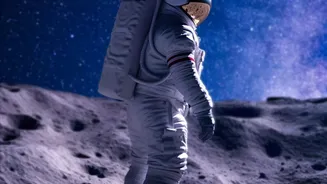
The lunar surface is one of the most hostile environments imaginable. With no atmosphere, it is bombarded by intense cosmic radiation, blasted by solar flares, and pelted by micrometeorites. Temperatures swing wildly, from a scorching 123°C in the day to a frigid -153°C at night. Building habitats to withstand this requires immense resources. Lava tubes, however, offer a natural solution. A ceiling of solid rock, potentially tens of meters thick, provides a near-perfect shield against radiation and impacts. Inside, temperatures are believed to be stable and almost comfortable, with one pit showing a consistent 17°C. They are ready-made real estate, waiting for us to move in.
Enter the Robotic Explorers
Before astronauts can set up camp, we need to know what’s inside. Are the tubes stable? Are the floors navigable? This is a job for robots. Several space agencies and private companies are developing specialized rovers to be the first lunar cavers. These are not your typical surface rovers. They must be able to operate in total darkness, navigate treacherous and unknown terrain, and function with a high degree of autonomy since direct communication from Earth is impossible underground. Mission concepts range from lowering a probe on a tether to deploying swarms of coordinated robots that work together to map the caves.
The Tech Behind the Trek
The European Space Agency (ESA) is evaluating concepts like DAEDALUS, a spherical, 'hamster-ball' like robot designed to be lowered into a pit and then roll autonomously to map the interior with cameras and LiDAR. NASA, meanwhile, has funded concepts like the Lunar Underground eXplorer (LUX), a hovering drone powered by a laser beamed through a fiber-optic tether from a surface rover. Other ideas involve teams of robots, like the SherpaTT, Coyote III, and LUVMI-X trio, which work together to rappel into and explore caves. Each design tackles the unique challenges of power, communication, and mobility required for this unprecedented exploration.
India’s Stake in the Lunar Future
This global quest has strong resonance with India's own space ambitions. ISRO's Chandrayaan-1 orbiter was instrumental in identifying a potential lava tube near the lunar equator, a massive structure about 2 km long. With the proven success of the Chandrayaan-3 mission's landing and rover operations, India has demonstrated its capability for complex surface missions. As the world looks towards establishing a permanent lunar presence, ISRO's expertise in cost-effective engineering and its growing portfolio of lunar science make it a key player. The exploration of lunar resources, including potential habitats like lava tubes, is a logical next step in securing India's role in the future space economy.