


First, Let's Ditch 'Zero Gravity'
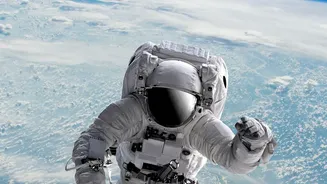
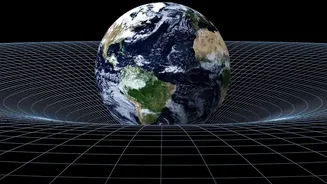
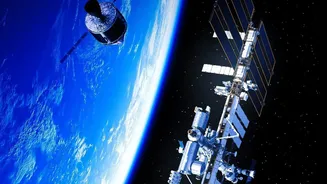
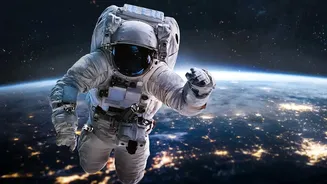
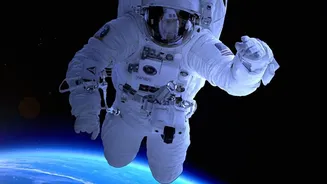
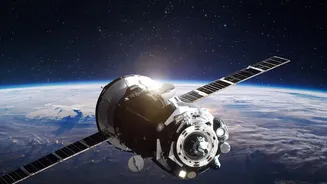
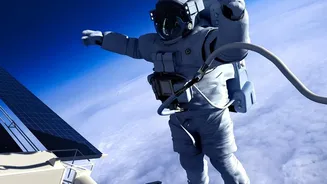
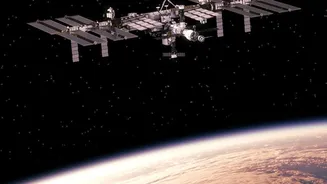
One of the biggest myths about space is that astronauts float because there’s no gravity. That’s simply not true. The International Space Station (ISS) orbits a few hundred miles above Earth, where gravity is still about 90% as strong as it is on the surface.
If you weigh 180 pounds on the ground, you'd weigh about 162 pounds at that altitude. So, gravity is definitely still in the picture, pulling on the station, the crew, and every object inside. The reason things appear to float has nothing to do with escaping gravity and everything to do with surrendering to it completely.
An Orbit Is Just Falling With Style
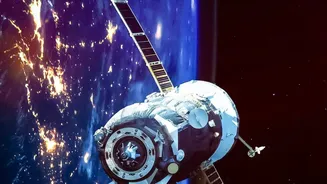
Imagine throwing a baseball. It travels forward, but gravity pulls it down, creating a curved arc until it hits the ground. Now, what if you could throw that ball so fast that as it arcs downward, the Earth's surface curves away from it at the exact same rate? The ball would keep falling, but it would never land. It would perpetually 'miss' the ground. That, in a nutshell, is an orbit. The ISS is traveling at roughly 17,500 miles per hour, a speed that perfectly balances its constant fall toward Earth with its forward momentum. It’s not flying; it’s falling, endlessly, around the planet.
The Elevator Thought Experiment
To understand why everything floats inside a falling spacecraft, let's use a more earthbound analogy: an elevator. Imagine you’re inside an elevator car and you take an apple out of your pocket. If the elevator is stationary, you feel your weight on the floor, and if you let go of the apple, it drops. Now, imagine the elevator's cable snaps. The car, you, and the apple all start to free-fall together, accelerating downward at the exact same rate. From your perspective inside the car, what happens when you let go of the apple? It doesn’t fall to the floor. It just hovers right there in front of you. You are both falling at the same speed, so there is no relative motion between you. This is precisely what happens aboard the ISS. The station, the astronauts, and any loose objects are all in a shared state of free-fall.
Welcome to 'Microgravity'
Because everything is falling in unison, the sensation of weight disappears. Weight isn't just the pull of gravity; it's the feeling of a surface—like the floor or a chair—pushing back against you. In free-fall, there is no upward push. This state is more accurately called 'microgravity', not zero gravity. The 'micro' prefix acknowledges that tiny residual forces, like atmospheric drag on the station or even an astronaut pushing off a wall, create minuscule accelerations that prevent the environment from being a perfect 'zero'. But for all practical purposes, it’s a world where up and down have no meaning, and everything from a water droplet to a human body behaves as if it's weightless.