





You may never visit the methane lakes of Saturn’s largest moon, but your name can. NASA is offering a unique chance to be part of history by sending your name to Titan aboard the groundbreaking Dragonfly mission.
Get Your Boarding Pass to Titan
Securing your spot on this interplanetary
journey is simple. NASA has opened a public registry, inviting people to have their names stencilled onto a microchip that will be attached to the Dragonfly rotorcraft. To participate, you can visit NASA's official 'Send Your Name with Dragonfly' website. After entering your details, you will receive a personalised digital boarding pass as a souvenir of your contribution to this historic mission. It's a symbolic but powerful way to connect with one of the most ambitious space exploration missions ever conceived. The deadline for submissions is January 15, 2027, so be sure to sign up and claim your piece of cosmic history.
Meet Dragonfly: A Revolutionary Flying Explorer
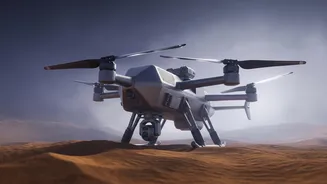
Dragonfly is unlike any spacecraft sent to another world. It is a car-sized, nuclear-powered rotorcraft—essentially a dual-quadcopter drone designed to fly through Titan's thick atmosphere. Instead of being confined to a single landing site like previous rovers, Dragonfly will be the first vehicle to perform powered, controlled flight on another moon. This mobility is a game-changer. During its planned 3.3-year science mission, Dragonfly will fly to dozens of different locations, some miles apart, to sample and analyse the moon's surface. Developed by the Johns Hopkins Applied Physics Laboratory (APL), this innovative approach will allow scientists to study a wide variety of geologic settings, from organic-rich sand dunes to the floor of an impact crater where liquid water may have once mixed with complex molecules.
Why Titan? A World of Intrigue
Saturn's moon Titan is one of the most fascinating destinations in our solar system and a top priority for astrobiology research. It is a world that is strangely similar to early Earth, with a thick nitrogen-rich atmosphere four times denser than our own. Titan has weather, clouds, mountains, and vast dune fields. But instead of water, its rivers, lakes, and seas are filled with liquid methane and ethane, and its rock-hard bedrock is made of water ice. This bizarre, cold world is rich in the complex, carbon-based organic molecules that are considered the building blocks of life. By studying Titan, scientists hope to gain invaluable insight into prebiotic chemistry—the chemical processes that occurred on Earth before life began.
The Mission's Search for Clues
Dragonfly's primary objective is not to find existing life, but to search for chemical clues about how life itself might begin. The mission will investigate the habitability of Titan's environment and explore how far its prebiotic chemistry has progressed. Its suite of instruments will analyse surface samples to identify complex organic compounds, including those essential for life as we know it, such as amino acids. One key target is the Selk crater, where scientists believe the heat from a past impact could have melted water ice, creating a temporary 'primordial soup' by mixing liquid water with Titan's abundant organic materials. The data gathered will help us understand the potential for life to arise on other worlds.
A Long Journey Ahead
Patience is a virtue in space exploration. The Dragonfly mission is scheduled to launch aboard a SpaceX Falcon Heavy rocket no earlier than July 2028. After its launch from Kennedy Space Center, the spacecraft will begin a long and complex journey through the solar system. It is expected to arrive at Titan in 2034, six years after leaving Earth. Once there, the real adventure begins, as the rotorcraft starts its series of flights, hopping across the alien landscape for over three years. Each flight will reveal more about this mysterious moon, sending back data and awe-inspiring images of a world billions of kilometres from home.