



Earth’s Invisible Shield
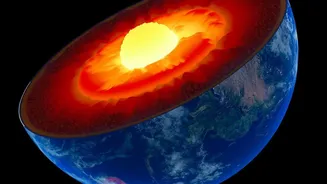
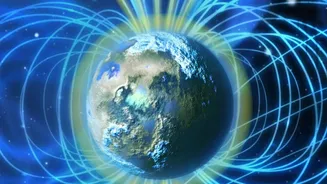
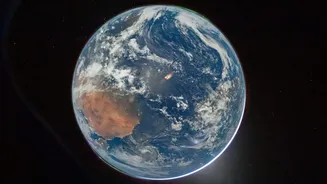
Deep beneath our feet, a giant engine of molten iron churns within the Earth’s outer core. This swirling, electrically conductive liquid generates a powerful magnetic field that envelops our planet. This field is not just a scientific curiosity that makes
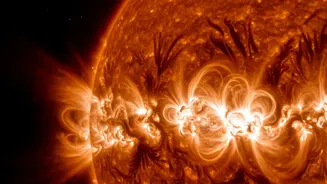
compasses point north; it is our primary defence against a constant barrage of charged particles from the sun, known as solar wind, and high-energy cosmic rays from deep space. Without this shield, harmful radiation would strip away our atmosphere and make life on the surface impossible. Think of it as a planetary force field, protecting the delicate biosphere from cosmic bombardment.
Why The Poles Flip
The same dynamic process that generates the magnetic field is also responsible for its instability. The movement of molten iron in the core is chaotic and turbulent, not smooth and predictable. Scientists believe that these complex fluid dynamics can sometimes cause the main magnetic field to falter and break down. Over thousands of years, the familiar north-south dipole collapses, and multiple, weaker 'north' and 'south' poles can temporarily pop up all over the planet. Eventually, the chaotic system reorganises itself, but there's a roughly 50-50 chance it will settle in the opposite orientation. This entire event is a magnetic pole reversal. It is a natural, albeit messy, feature of how our planet works.
A Slow, Not Sudden, Event
The idea of a pole reversal often conjures images of a sudden, world-flipping catastrophe. The reality is far less dramatic and much, much slower. A full reversal is not an overnight switch but a gradual process that can take anywhere from 1,000 to 10,000 years to complete. The last full reversal, known as the Brunhes-Matuyama reversal, occurred about 780,000 years ago. So, while we are technically 'overdue' based on the long-term average, these events are not on a predictable timetable. During the transition, the main effect is a significant weakening of the magnetic field’s shielding power, perhaps down to 10% of its current strength.
Impact On Life And Nature
What would this weakened shield mean for life? The fossil record shows no evidence linking past pole reversals to mass extinctions. Life, it seems, is resilient. However, a weaker field would allow more radiation to reach the surface, which could increase rates of genetic mutation. The more noticeable effect might be on animals that use the magnetic field for navigation. Migratory birds, sea turtles, and some fish rely on an internal magnetic sense, or magnetoreception, to guide their journeys. A chaotic, multi-polar field would be like taking their map and compass away, likely causing widespread disorientation. Yet, as history shows, species have survived dozens of these events.
The Real Threat To Our Modern World
The most significant and disruptive consequences of a pole reversal would be to our technology-dependent civilisation. Our modern infrastructure is exceptionally vulnerable to the very things the magnetic field protects us from. With a weakened shield, powerful solar flares and cosmic rays that are normally deflected would hit us hard. They could knock out satellites, crippling GPS, global communications, and financial transactions. They could also induce massive electrical currents in our power grids, causing continent-spanning blackouts that could last for months or even years. Every device with a microchip, from your phone to hospital equipment, would be at risk.