
First, What Is the Helix Nebula?
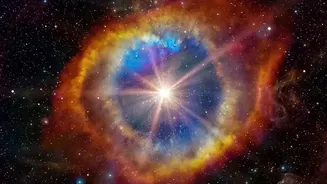
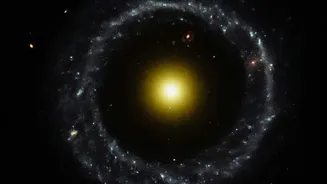
Before diving into the knots, it helps to know where they live. The Helix Nebula, located about 650 light-years away, is one of the closest and most famous examples of a planetary nebula. Despite the name, it has nothing to do with planets. Instead, it’s
the beautiful, glowing remnants of a star that was once like our own sun. As the star reached the end of its life, it shed its outer layers of gas into space. The hot, dense core of the star, called a white dwarf, now sits at the center, blasting the surrounding gas with intense radiation and making it glow. Think of it as a star's final, glorious farewell.
So, What Are These 'Cometary Knots'?
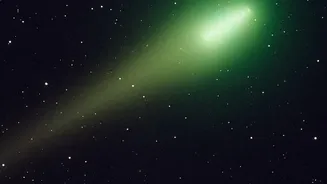
These are not actual comets. They get their name because they look like them, with bright, compact heads and long, streaming tails. First discovered in detail by the Hubble Space Telescope, astronomers found thousands of these structures dotting the inner ring of the nebula. While they may look small from here, they are astronomically huge. Each knot's head is roughly twice the size of our solar system, and their tails can stretch for 100 billion miles. Each one contains about as much mass as the Earth. For years, their very existence was a puzzle. How could these relatively dense, cool clumps of gas and dust survive in the chaotic, high-energy environment of a dying star?
An Old Theory Gets a Webb Upgrade
The long-standing hypothesis was that these knots formed when blistering hot, fast-moving winds from the central star crashed into cooler, slower-moving gas the star had ejected thousands of years earlier. This cosmic collision would cause the cooler gas to fragment into the dense, tadpole-shaped droplets we see today. It’s like a fast wind blowing over the surface of a pond, creating ripples and droplets. Webb’s unparalleled infrared vision has now given scientists the clearest view yet of this process in action. The new images show these pillars in stunning detail, right at the boundary where the hot and cool gases are interacting.
Webb's Surprising Discovery
Here's where it gets really interesting. The intense radiation from the central star should, in theory, destroy the fragile molecules within these knots. But Webb’s instruments detected the signature of molecular hydrogen—a molecule that shouldn't be able to survive the harsh conditions—thriving inside them. The knots are so dense that their outer layers act like a shield, protecting the delicate molecules hidden within their tails. These protected pockets serve as cosmic laboratories where dust and more complex molecules can form, sheltered from the star's destructive glare.
Why This Cosmic Detail Matters
Studying these cometary knots isn't just about admiring a beautiful celestial object. It’s about understanding the lifecycle of stars and the universe's recycling program. The material expelled by dying stars, including the molecules preserved within these knots, gets sent back out into the cosmos. This recycled gas and dust becomes the raw material for the next generation of stars and, eventually, new planets. By seeing how these molecules survive a star’s death throes, we get a glimpse into how the essential ingredients for worlds like our own are preserved and distributed across the galaxy. The Helix Nebula isn't just an ending; it’s the very beginning of a new cosmic story.