





The Orbital Junkyard Problem
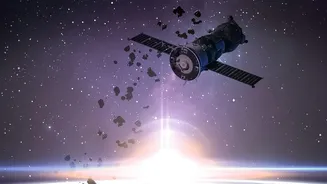
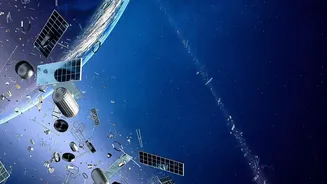
Since the launch of Sputnik in 1957, humanity has been populating Earth's orbit. Today, thousands of active satellites for communication, navigation, and science share the skies with an ever-growing cloud of space debris. This junk consists of defunct
satellites, spent rocket stages, and fragments from past collisions and explosions, numbering in the tens of thousands of trackable objects. Traveling at speeds over 28,000 kilometres per hour, even a tiny piece of debris can strike with enough force to cripple a functioning satellite or endanger crewed missions like the International Space Station. This has led to the frightening possibility of the Kessler Syndrome, a chain reaction where collisions create more debris, leading to more collisions until low Earth orbit becomes virtually unusable.
The Trouble with Nets and Harpoons
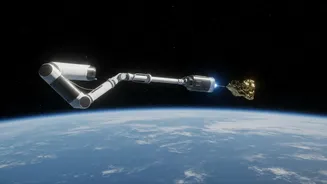
Early concepts for active debris removal (ADR) often sound like something from a sci-fi film: giant nets, robotic arms, and harpoons. While innovative, these 'contact-based' methods come with significant risks. To capture a piece of debris, the cleanup satellite must first match its orbit and velocity, which is a fuel-intensive process. Then comes the capture, a delicate and dangerous maneuver. A harpoon strike or a net deployment gone wrong could cause the target object to break apart, creating even more hazardous debris. One study showed that using a net to capture a large satellite like Envisat had a high likelihood of breaking off its solar array, generating a massive new piece of debris. Furthermore, many junked satellites are tumbling uncontrollably, making a physical capture even more precarious.
Enter the Magnetic Tether
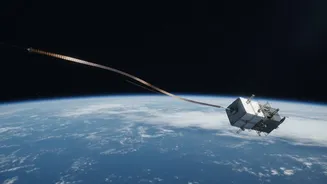
Magnetic and electrodynamic tethers offer a fundamentally different, and safer, approach. Instead of a violent physical capture, these systems use the principles of electromagnetism to interact with debris from a distance or with minimal force. An electrodynamic tether is a long, conductive tape, sometimes several kilometres long, that is unspooled from a satellite. By interacting with Earth's magnetic field and the surrounding plasma, it can generate a current. This creates a force known as Lorentz drag, which acts as a brake, slowing the tethered object and causing its orbit to decay until it safely burns up in the atmosphere. This method is propellant-less, relying on fundamental physics to do the work.
The Safety of a Gentle Nudge
The primary safety advantage of magnetic concepts is their non-contact or gentle-contact nature. Some systems use powerful electromagnets to generate a rotating magnetic field. This field induces eddy currents in any conductive debris, like the common aluminum used in satellites. These eddy currents create a secondary magnetic field, allowing the cleanup satellite to essentially grab, slow, and steer the debris without ever touching it. This eliminates the risk of creating more fragments from a high-speed impact. It allows for the safe capture of fragile or tumbling objects that would be too risky for a harpoon or net. For systems that do attach, like an electrodynamic tether, the connection is designed to be part of a controlled deorbit maneuver, gently pulling the object out of orbit rather than wrestling with it.
The Road Ahead and Real-World Tests
This technology is moving from theory to practice. Companies like Tethers Unlimited have developed products like the 'Terminator Tape', a device designed to be attached to satellites before launch. In a demonstration mission called Dragracer, a satellite equipped with the 70-meter tape re-entered the atmosphere in just eight months, while its identical twin without the tape is expected to remain in orbit for at least seven years. European initiatives like the E.T.PACK-Fly project are also developing electrodynamic tethers to deorbit launcher stages, with demonstration flights planned. While challenges remain in scaling these technologies to capture pre-existing, non-cooperative debris, the principles have been proven. They offer a scalable, fuel-free, and most importantly, safer pathway to a cleaner orbital environment.