







What Exactly is Adaptive Learning?
Imagine a tutor who knows exactly what you've mastered and where you're struggling, moment by moment. That’s the core idea behind adaptive educational software. Instead of presenting a fixed set of questions or lessons, this technology uses artificial
intelligence (AI) to adjust the learning material in real time based on a student’s performance. It moves away from the traditional 'one-to-many' broadcast model of teaching, where one teacher addresses a classroom of diverse learners, and shifts towards a 'one-to-one' digital experience. This isn't just about getting a question right or wrong; the software analyses patterns in a student's responses to build a dynamic profile of their knowledge and skills.
From Static Test to Dynamic Journey
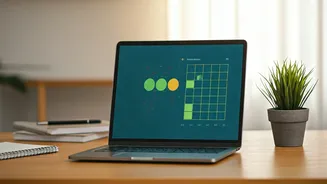
The traditional exam is a snapshot in time. It tells you what a student knew on a specific day, but offers little insight into their learning process. Adaptive tests transform this static event into a dynamic journey. Here’s how it works: a student starts with a question of medium difficulty. If they answer correctly, the AI serves up a slightly harder question to challenge them and gauge the upper limit of their understanding. If they get it wrong, the system presents an easier question or even a quick tutorial on the underlying concept they seem to have missed. This continuous feedback loop means no two students will have the exact same test experience. The test becomes a diagnostic tool that actively maps out a student's personal landscape of knowledge, identifying strongholds and areas that need reinforcement.
The AI Behind the Curtain
The magic lies in sophisticated algorithms. These AI engines are built on principles from learning science and data analytics. They don't just track correct or incorrect answers; they can analyse the time taken to answer, the type of mistakes made, and which concepts are repeatedly causing trouble. For example, if a student consistently falters on questions involving fractions, the system flags this as a specific knowledge gap. It can then generate a custom 'remedial path' for that student, offering videos, practice exercises, and simpler problems focused exclusively on fractions until mastery is achieved. This ensures that foundational concepts are solid before the student is moved on to more complex topics, preventing the common problem of learning gaps widening over time.
A Powerful Tool for Teachers
While this technology is student-centric, its biggest beneficiaries might just be teachers. Drowning in administrative tasks and the pressure of large class sizes, educators often lack the time to give every student individualised attention. Adaptive software automates the diagnostic process. Instead of manually grading 30 nearly identical papers, a teacher receives a detailed dashboard. This dashboard can show, at a glance, that 70% of the class is struggling with a particular chapter, or that three specific students need extra help with a certain formula. This data allows teachers to move from being lecturers to becoming learning facilitators. They can use their valuable classroom time for targeted interventions, small group discussions, and addressing the precise needs their students have, as revealed by the AI.
The Road Ahead in India
The potential for adaptive learning in a country as vast and diverse as India is immense. Major EdTech platforms are already integrating these features, offering personalised learning paths for everything from school curriculums to competitive exam preparation. However, the path to widespread adoption is not without its hurdles. The digital divide remains a significant barrier, with inconsistent access to reliable internet and devices in many parts of the country. Furthermore, there's a need for comprehensive teacher training to help educators effectively interpret the data and integrate these tools into their pedagogy. Ensuring the AI is unbiased and caters to different linguistic and cultural contexts is another critical challenge. For this transformation to be truly equitable, it must be accessible to all, not just a privileged few.