


A New Frontier in Planet Hunting
For decades, finding planets outside our solar system—known as exoplanets—was a monumental achievement in itself. We could detect their presence, estimate their size, and measure their orbits. But a fundamental question remained tantalizingly out of reach:
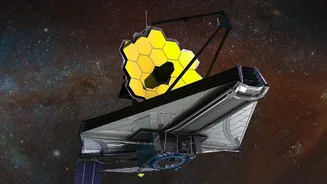
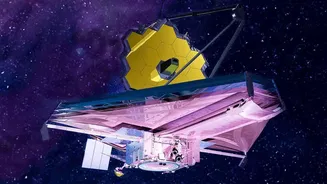
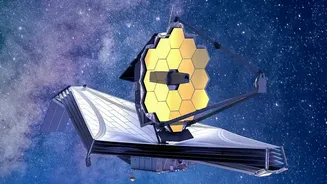
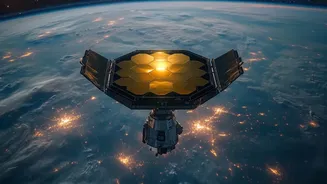
what are they really like? The James Webb Space Telescope has changed the game. It is taking us from merely detecting exoplanets to truly characterizing them. For the first time, we have the technology to analyze the chemical makeup of their atmospheres, a crucial step in determining if a world could be habitable. Webb’s powerful infrared instruments are providing the first detailed chemical fingerprints of these alien worlds.
What Exactly Is a Super-Earth?
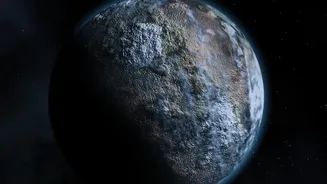
Super-Earths are a class of planet with no direct comparison in our own solar system. They are more massive and larger than Earth but smaller than our ice giants, Neptune and Uranus. This category encompasses a wide variety of worlds—some could be dense, rocky planets, while others might be water worlds covered in deep oceans. Because our solar system lacks a planet in this size range, super-Earths are a major mystery. They are, however, extremely common throughout the galaxy, making them a prime target for astronomers trying to understand the full spectrum of planetary formation and the potential for life elsewhere.
How Webb Reads an Alien Sky
So, how does JWST "map" an atmosphere from light-years away? The primary method is called transmission spectroscopy. When an exoplanet passes in front of its host star from our perspective, a tiny fraction of the starlight filters through the planet's atmosphere. Different gases and molecules in that atmosphere absorb specific wavelengths, or colors, of light. This leaves a unique chemical signature imprinted on the starlight that reaches the telescope. By analyzing which colors are missing, scientists can deduce the presence of elements like water vapor, carbon dioxide, and methane. It’s like using the star as a giant backlight to reveal the atmospheric composition of the planet in silhouette.
First Glimpses of Rocky World Atmospheres
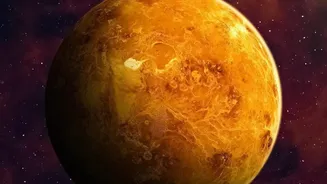
Recent findings from JWST have provided the best evidence to date for atmospheres around rocky exoplanets. One major target is 55 Cancri e, a blistering hot super-Earth orbiting so close to its star that its surface is likely a molten magma ocean. Scientists expected it to be a bare rock, its atmosphere long-since stripped away by intense radiation. However, Webb’s observations detected gases like carbon monoxide and carbon dioxide. This suggests the planet has a "secondary" atmosphere, one that is continuously being replenished by gases bubbling out from its molten interior.
The Search for Water and Habitability
While a lava world like 55 Cancri e is far too hot for life, other discoveries are more tantalizing. JWST has also studied LHS 1140 b, a super-Earth located in its star's habitable zone—the orbital region where temperatures could allow liquid water to exist on the surface. Observations have ruled out a hydrogen-dominated atmosphere, and instead point toward a heavier atmosphere, possibly containing nitrogen and water vapor. This makes it one of the most promising candidates for a potential water world. While detecting water vapor is not proof of life, it's a critical ingredient, and finding it on a rocky world in the habitable zone is a monumental step in the right direction.