






A Planet on a cosmic schedule
To understand why TOI-2535 b's disappearance is so significant, we first need to talk about how astronomers find planets light-years away. One of the most successful techniques is the 'transit method'. When a planet's orbit takes it directly between its
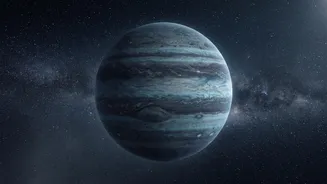
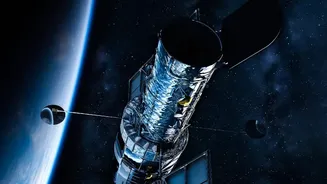
star and Earth, it blocks a tiny fraction of the star's light, causing a temporary, measurable dip in brightness. For years, NASA's Transiting Exoplanet Survey Satellite (TESS) watched TOI-2535 b do just that. Located about 1,000 light-years away, this massive gas giant, known as a 'hot Jupiter', completes a blisteringly fast orbit around its star in just over eight days. These regular transits allowed scientists to confirm its existence and study its orbit.
The Case of the Missing Planet
Astronomers expect planetary systems to run with a certain regularity. But TOI-2535 b began to defy this expectation. Over seven years of observation, its transits started becoming erratic, arriving up to six hours earlier or later than predicted. Then, in March 2026, the planet seemingly vanished. The expected dip in starlight from its transit never came. Of course, the planet didn't actually disappear. Instead, something has pulled it out of our line of sight. It's the first time astronomers have directly observed a confirmed planet's transits stopping in this manner.
The Clue in the Wobble
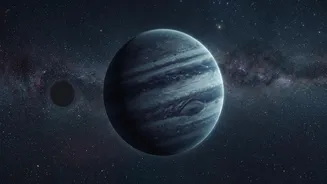
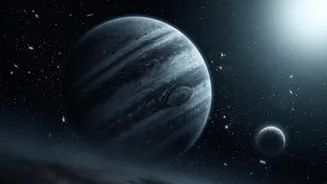
This strange behaviour is a classic sign of something called Transit Timing Variations, or TTVs. Imagine a lone planet orbiting its star—its path should be quite regular. But if another planet is in the system, its gravitational pull can tug on the first planet, causing it to speed up or slow down slightly in its orbit. This causes its transits to occur off-schedule. In the case of TOI-2535 b, the variations were extreme. Scientists now believe an unseen neighbouring planet, likely at least the mass of Saturn, is locked in a gravitational tug-of-war with TOI-2535 b. This interaction is causing the orbits of both planets to wobble like a top, and TOI-2535 b's orbit has now tilted so much that it no longer crosses its star from our viewpoint.
From Anomaly to Discovery
What seems like a failed observation is actually a thrilling scientific opportunity. The 'disappearance' of TOI-2535 b is a powerful piece of evidence for the existence of its hidden neighbour. By modelling the extreme wobble and timing variations, astronomers can deduce the mass and likely orbit of this second, unseen planet. This is a prime example of how gravitational interactions can reveal worlds that don't transit their star at all. The dramatic orbital tilt also provides clues about how this planetary system formed. Such a wobbly system suggests a more chaotic history than the gentle, orderly formation process often assumed for multi-planet systems.
What Happens Next?
The cosmic game of hide-and-seek is far from over. Based on current models, astronomers don't expect to see TOI-2535 b transit its star again for at least 30 years. However, there's a chance its hidden companion could wobble into our line of sight much sooner. The ongoing study of this system highlights a crucial point: the universe is not always the perfect, clockwork machine we might imagine. Instead, it is a dynamic and evolving place where even a 'missing' planet can tell us more than a perfectly punctual one. The mystery of TOI-2535 b has turned an observational loss into a major clue about the complex dance of planets in distant star systems.