



The United Nations Secretary-General is often called the world’s top diplomat. But their appointment isn't a global election. It hinges on a series of secret ballots within the Security Council, a process that is far from transparent.
What Are Straw Polls?
The UN Charter is
brief, stating only that the General Assembly appoints the Secretary-General upon the recommendation of the Security Council. To reach this recommendation, the Council uses an informal process called a 'straw poll'. These aren't formal votes. Instead, they are secret ballots used to gauge support for candidates without triggering a formal veto. In these polls, the 15 Council members vote to either 'encourage', 'discourage', or express 'no opinion' on each candidate. This allows the Council to quietly test the waters and see which candidates are viable and which face insurmountable opposition, long before any official decision is made. The process was devised to avoid public stalemates and the early casting of formal vetoes, which could compromise a future Secretary-General.
The Power of the Security Council
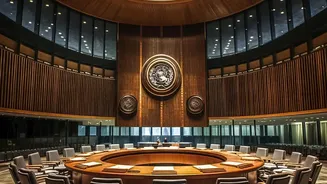
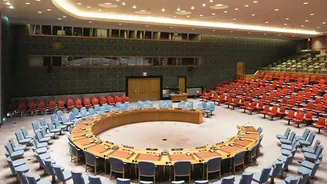
The Security Council consists of 15 members, but the power is not shared equally. Five nations—China, France, Russia, the United Kingdom, and the United States—are permanent members, known as the 'P5'. These were the primary victors of World War II, and they hold their seats permanently. The other ten members are elected by the General Assembly for two-year terms. To be recommended, a candidate needs at least nine 'encourage' votes from the Council. Crucially, they must not receive a veto from any of the five permanent members. This gives the P5 ultimate gatekeeping authority. While the 193-member General Assembly technically appoints the Secretary-General, it has never rejected a candidate recommended by the Security Council. For decades, the Council simply presented a single name for the Assembly to rubber-stamp.
Color-Coded Ballots and the Veto
To make things more complex, the straw poll process has two phases. Early rounds use identical white ballots, so the results are anonymous. As the field narrows, the Council switches to 'color-coded' ballots. The ten elected members continue to use white ballots, but the five permanent members use ballots of a different color, often red. This instantly reveals whether a 'discourage' vote comes from an elected member or a P5 nation. A 'discourage' vote on a colored ballot is not a formal veto, but it acts as a clear signal of one. Any candidate who receives such a vote knows their path is likely blocked, as the P5 member is signaling they will use their official veto in a formal vote. This system allows the P5 to eliminate candidates without having to publicly cast a formal veto.
A Push for More Transparency
For most of the UN's history, this entire process happened behind closed doors. However, growing frustration from the wider UN membership led to calls for reform. Since 2015, the process has become more open. Candidates now submit vision statements and campaign financing disclosures, and they participate in public, webcast dialogues with the General Assembly. This gives all 193 member states a chance to hear from and question the candidates. Civil society groups have also campaigned for more openness, urging the Council to publish straw poll results and reduce secrecy. Despite these improvements, the core of the decision-making process remains within the Security Council, where the color-coded ballots and the threat of a veto still hold the real power. The changes have added a layer of public scrutiny but have not fundamentally altered the P5's control.