

Whispers of Water Across the Cosmos
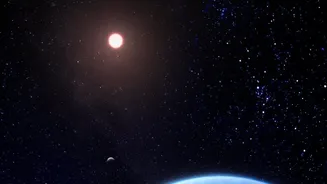
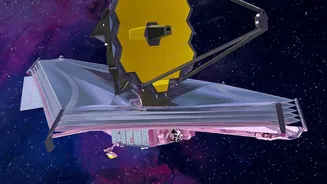
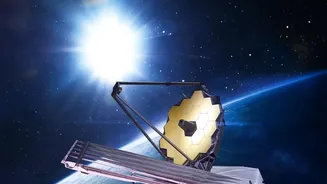
The search for habitable planets often begins with a simple question: is there water? Thanks to the JWST, astronomers are getting closer to an answer. The telescope has successfully identified water vapour in the atmospheres of several exoplanets, which
are planets outside our solar system. One recent discovery involved detecting water in the inner disk of a young star system called PDS 70, the very region where rocky planets like Earth are thought to form. This suggests that the essential ingredients for life might be available to planets from their very birth. These findings represent a significant leap forward, proving our technological ability to peer into the chemical makeup of alien worlds dozens or even hundreds of light-years away.
Meet the Super-Earths
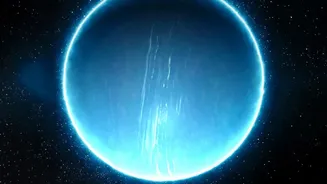
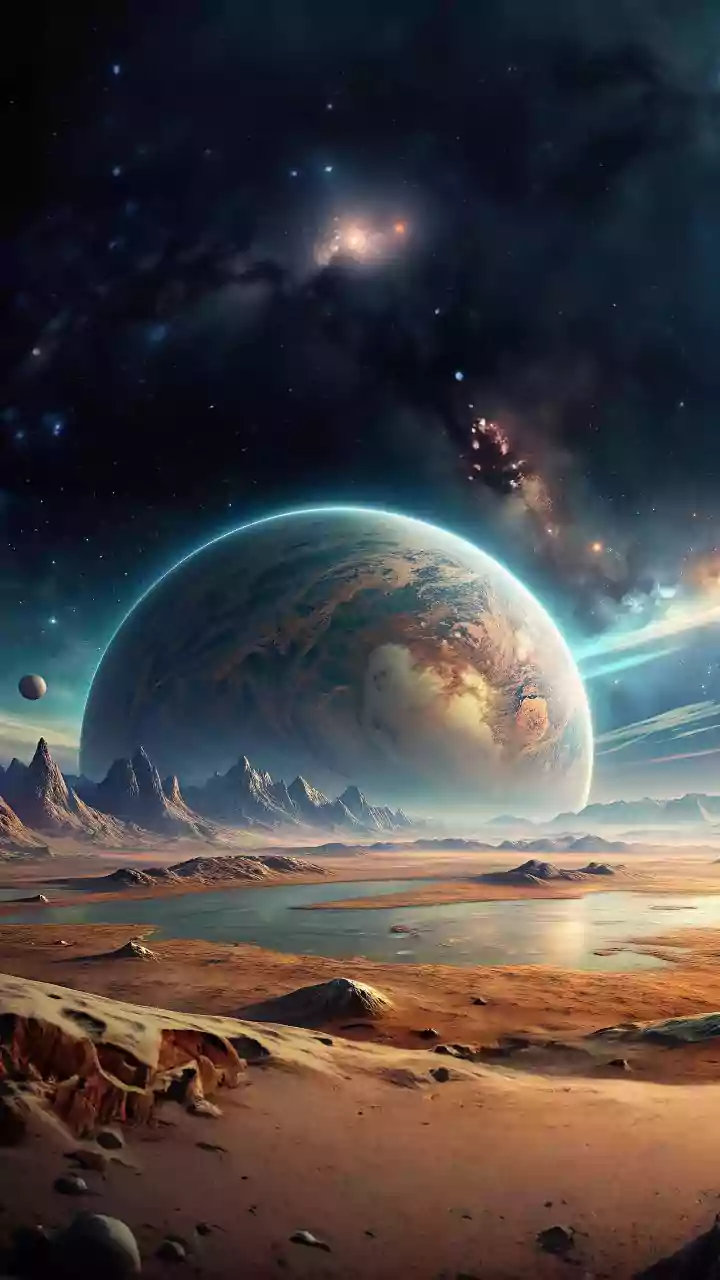
Many of these discoveries centre on a fascinating class of planets known as "super-Earths." These are worlds with a mass greater than Earth's but less than that of Neptune. They are one of the most common types of planets found in our galaxy, yet our own solar system curiously lacks one. This makes them a major focus for astronomers. Their size and mass could give them a better chance of retaining an atmosphere and supporting geological activity, both crucial factors for long-term habitability. Some may be rocky worlds, while others could be entirely covered in deep oceans, so-called "water worlds." The headline-grabbing discoveries often involve super-Earths because their size makes their atmospheres slightly easier to study than those of smaller, Earth-sized planets.
The Telescope's Secret Weapon
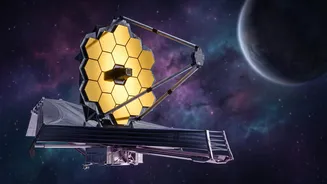
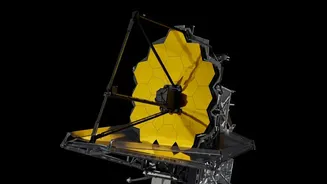
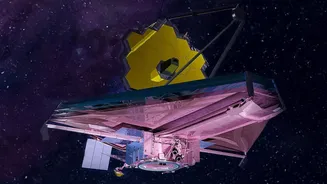
So, how exactly does the JWST detect something as specific as water from such an immense distance? The technique is called transit spectroscopy. When an exoplanet passes in front of its host star from our point of view, a tiny amount of starlight filters through the planet's atmosphere. The JWST's incredibly sensitive instruments capture this light and analyse its spectrum. Different molecules in the atmosphere absorb light at specific wavelengths, leaving a unique chemical fingerprint. By looking for the tell-tale gaps in the spectrum, scientists can identify the presence of molecules like water vapour, methane, and carbon dioxide. It is this revolutionary capability that allows astronomers to perform a chemical census of worlds we can never hope to visit.
More Than Just Water
While water is a key target, the JWST is finding a whole suite of interesting molecules. On the exoplanet K2-18 b, a world 8.6 times the mass of Earth, the telescope found not only signs of a water ocean but also methane and carbon dioxide. The presence of these carbon-bearing molecules on a potential "Hycean" world (a planet with a hydrogen-rich atmosphere over a water ocean) is incredibly exciting for astrobiologists. The observations of K2-18 b also included a possible detection of a molecule called dimethyl sulfide (DMS). On Earth, DMS is overwhelmingly produced by life, particularly marine phytoplankton. While this detection is still tentative and requires more data to confirm, it's one of the most intriguing biosignatures found to date.
A Dose of Scientific Caution
As thrilling as these discoveries are, scientists are quick to advise caution. Finding water vapour does not automatically mean we have found a habitable world. For instance, observations of the rocky super-Earth GJ 486 b also showed signs of water, but researchers are uncertain if the signal came from a planetary atmosphere or from the cool starspots of its host star. Many of these planets are also far too hot for liquid water to exist on their surfaces. GJ 486 b, for example, has a surface temperature of around 430 degrees Celsius. An atmosphere on such a world would likely be a thick, scorching steam. These findings are not a confirmation of Earth 2.0, but rather a testament to a new, powerful tool in our astronomical arsenal.