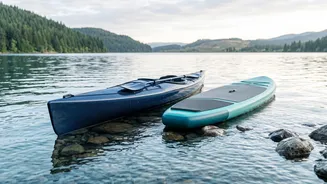







At a glance, kayaking and stand-up paddleboarding (SUP) seem like similar upper-body workouts. But beneath the surface, these two popular water sports engage your arms and shoulders in fundamentally different ways. It’s not just about pulling a paddle.
The Kayaking Stroke: A Rotational Powerhouse
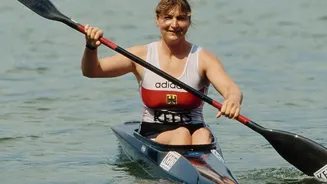
Many beginners assume kayaking is an arm-dominant sport, only to end a session with tired back and core muscles. That's because a proper kayaking stroke is a full-body movement where the power originates from torso rotation. Your legs press against footrests for stability, your core and oblique muscles twist, and your back muscles, particularly the large latissimus dorsi ('lats'), do the heavy lifting. In this kinetic chain, your arms and shoulders act as the crucial link, transferring the force generated by your core to the double-bladed paddle. One arm pulls the blade through the water while the other simultaneously pushes forward, creating a fluid, powerful cycle. This means the workout is less about isolated arm strength and more about integrated, rotational power.
Kayaking's Impact on Arms and Shoulders
The primary motion in kayaking is a dynamic push-and-pull. As one arm pulls the paddle blade back, your biceps and rear deltoids (shoulders) are engaged. Simultaneously, the other arm pushes its blade forward, activating the triceps and front deltoids. This constant, alternating sequence provides a balanced workout for the muscle groups on the front and back of your upper arms and shoulders. However, this repetitive overhead motion can also place significant strain on the rotator cuff—the small stabilizing muscles of the shoulder—if technique is poor or the core isn't properly engaged. Experienced kayakers learn to minimize this strain by relying on larger back muscles and core rotation, using their arms more as struts than primary movers.
The Paddleboarding Stroke: A Vertical Pull
Stand-up paddleboarding introduces a completely different challenge: balance. Standing on an unstable surface forces constant engagement from your legs, glutes, and deep core stabilizers just to stay upright. Unlike the seated, rotational motion of kayaking, the SUP stroke is a more vertical, downward pull. You reach forward with a long, single-bladed paddle, 'plant' the blade in the water, and then pull your body past the paddle, engaging your core and back. The primary muscles driving the stroke are still the lats and core, but the mechanics are different. Your arms work to stabilize the paddle and transfer power, but the standing position changes how the shoulders are loaded.
Paddleboarding's Arm and Shoulder Workout
In SUP, the top arm and shoulder act as a stable pivot point, while the bottom arm helps pull the paddle blade through the water. This motion heavily recruits the deltoids, lats, and trapezius muscles. The triceps are engaged as you push down on the paddle handle, while the biceps play a role in the pulling phase. Because you are standing, the angle of force is more downward and less rotational compared to kayaking. This can be less stressful on the shoulder's rotator cuff for some people, as the top hand generally stays below eye level. However, maintaining grip and control over the long paddle builds significant endurance in the forearms and stabilizing muscles of the shoulder.
Direct Comparison: Push-Pull vs. Downward Drive
The core difference in arm and shoulder work comes down to the fundamental movement. Kayaking is defined by a horizontal, rotational push-pull. It builds strength and endurance symmetrically through the front and back of the shoulders and arms. Paddleboarding is characterized by a vertical, downward pull and stabilization. It builds endurance and strength through a pulling motion while also demanding constant isometric work from the shoulder stabilizers to maintain balance and control the paddle. Kayaking offers a more intense upper-body endurance workout, while SUP provides a more comprehensive full-body challenge with a focus on stability.
Which Is Better for Your Fitness Goals?
Neither sport is definitively 'better'; they simply offer different benefits. If your goal is to build powerful upper-body and back endurance with a focus on rotational strength, kayaking is an excellent choice. It provides a fantastic cardiovascular workout and heavily targets the lats, shoulders, and arms in a rhythmic, powerful way. If you're looking for a total-body workout that challenges your balance, strengthens your deep core muscles, and provides a slightly less intense but highly effective upper-body workout, SUP is the winner. It excels at building stabilizer muscle strength from your feet to your shoulders, creating lean, endurance-based muscle tone.