





The Challenge of Long-Term Consistency
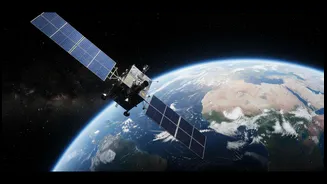
Detecting the subtle, long-term trends of climate change requires decades of continuous, stable, and highly accurate data. Earth-observing satellites are essential, but they are built by different agencies at different times, using different technologies.
Over time, a sensor's sensitivity can degrade in the harsh environment of space. When one satellite is replaced by another, there can be tiny differences in their measurements. These small discrepancies can add up, creating uncertainty and making it difficult to distinguish a true climate trend from an instrumental artifact. For decades, scientists have faced the challenge of stitching together these disparate datasets into a single, reliable climate record. Many sensors were designed for short-term weather forecasting, not the meticulous, high-accuracy observations needed for climate science.
A Calibration Standard in Orbit
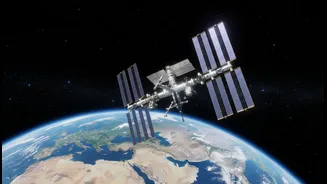
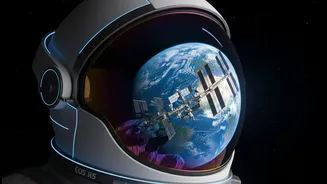
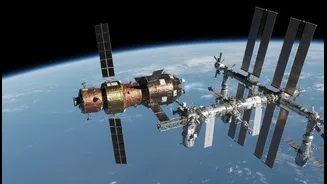
Enter CLARREO Pathfinder. Hosted on the International Space Station (ISS), this mission is not just another climate sensor; it is a metrology lab in orbit. Its primary job is to serve as a highly accurate reference point—a 'tuning fork' for other instruments. The mission has two key objectives: first, to demonstrate it can make measurements of reflected sunlight with unprecedented accuracy, directly traceable to international scientific standards. Second, it will demonstrate how to transfer that high accuracy to other sensors orbiting Earth, such as the CERES and VIIRS instruments, which are vital for monitoring Earth's energy budget. By making simultaneous, matched observations of the same spot on Earth, CLARREO Pathfinder can tell scientists precisely how to adjust the data from other satellites, effectively calibrating them from space.
How It Achieves Unprecedented Accuracy
The instrument at the heart of the mission is a reflected solar spectrometer. It measures the spectrum of sunlight that bounces off the Earth and its atmosphere. What makes it unique is its rigorous calibration system. While most instruments are calibrated on the ground and can only track their changes in space, CLARREO Pathfinder can repeatedly recalibrate itself in orbit by scanning the Sun and the Moon, which are stable and well-understood light sources. This allows it to maintain its high accuracy throughout its mission, achieving measurements five to ten times more precise than existing sensors. This breakthrough in accuracy is the key to creating a 'gold standard' data record that can be used to anchor all other measurements, past, present, and future.
More Than Just Temperature
The hyperspectral measurements taken by CLARREO Pathfinder contain a wealth of information. By analyzing the detailed 'fingerprint' of reflected sunlight across hundreds of wavelengths, scientists can better understand the properties of clouds, tiny atmospheric particles called aerosols, sea ice, and land surfaces. For example, different cloud types reflect light differently, and these differences have a huge impact on how much of the Sun's energy is trapped in our climate system. More accurate data on these variables is crucial for improving climate models. The mission, which achieved 'first light' in the summer of 2026 by capturing its first detailed spectral images from the ISS, provides data that helps scientists understand these complex systems with greater certainty.
Strengthening Confidence in Our Climate Future
Ultimately, the purpose of collecting this data is to build and refine the climate models that forecast future changes. The more accurate the input data, the more reliable the model's predictions. By reducing the uncertainty in our fundamental observations of Earth’s energy balance, CLARREO Pathfinder helps to sharpen these predictive tools. This allows scientists to detect climate change trends decades sooner than would otherwise be possible. A clearer understanding of how the climate is changing, and the ability to attribute those changes correctly, provides policymakers with the solid, unequivocal information needed to make effective decisions on everything from infrastructure planning to global climate agreements.