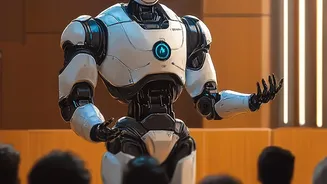







The Illusion of Understanding
The biggest mistake students make with AI is mistaking a generated answer for genuine knowledge. Over-reliance on AI tools for completing tasks is known as “cognitive offloading,” where you outsource the mental effort required for learning. While this
might feel efficient, it bypasses the essential struggle that builds deep understanding. True learning often happens during the process of trying, failing, and figuring things out on your own. Studies have shown that while AI can reduce cognitive load, it can also lead to poorer reasoning and argumentation skills if not used carefully. Students who use AI to skip foundational work often struggle later with more complex concepts. The goal isn't just to submit a finished assignment, but to actually learn the material in a way you can recall and apply in the future.
From Answer Machine to Thinking Partner
The most effective way to use AI is not as a content generator, but as a thinking partner. Instead of asking, “What is the answer?”, you can use AI to challenge and deepen your own thinking. For instance, after you’ve formulated a thesis for an essay, ask the AI to generate counterarguments. This forces you to consider different perspectives, identify weaknesses in your reasoning, and strengthen your overall analysis. You can also use it as a personal tutor, asking it to explain complex topics in simpler terms or to quiz you on your understanding. This approach transforms AI from a shortcut into a tool that fosters intellectual engagement and curiosity.
Developing Irreplaceable Human Skills
In a world where AI can produce content instantly, the skills that truly matter are the ones that can't be automated: critical thinking, creativity, and analytical reasoning. Getting a fast answer from an AI does nothing to build these abilities. In fact, over-reliance can cause them to decline. The real value in education lies in learning how to evaluate information, verify sources, and construct a coherent argument in your own voice. Remember that AI models can be biased, inaccurate, or simply invent information. The ability to critically assess an AI's output, fact-check its claims, and refine its suggestions is an essential skill for the modern world. These are the durable, 'slow' knowledge skills that employers value and that machines cannot replicate.
A Practical Guide to Using AI Smartly
So, how can you use AI without losing the learning? First, always check your instructor's policy on AI use for your specific course. Assuming it's permitted, start by doing your own work. Grapple with the material yourself before turning to AI. When you do use it, be intentional. Use it to brainstorm ideas, create an outline, or find new angles on a topic. Learn to write effective prompts that guide the AI toward deeper insights rather than simple answers. For example, instead of “Write an essay on climate change,” try “Act as a debate partner and challenge my argument that solar power is the best solution for India's energy needs.” Always review, edit, and fact-check any information the AI provides. And finally, make sure the submitted work is fundamentally yours—your thoughts, your structure, and your voice. When used this way, AI supplements your learning instead of replacing it.