


It’s a sight so common we barely notice it: a seaside puddle dries in the sun, leaving a delicate, white crust behind. Or maybe it’s the bottom of a pot after salty water boils away. But how does this transformation happen? Let’s dive in.
The Invisible Dance of Dissolving
The process begins
with saltwater, which is a solution of sodium chloride (NaCl) and water. When salt is stirred into water, it seems to vanish. What's really happening is a molecular tug-of-war. Water molecules are great at pulling things apart. They surround the individual sodium (Na+) and chloride (Cl-) ions that make up the salt, breaking their bonds and allowing them to float freely and invisibly within the water. At this stage, the salt is completely dissolved, its ions dispersed throughout the solution.
When the Water Leaves
Evaporation is the game-changer. Whether caused by the sun's heat or a stove's flame, evaporation is the process where liquid water turns into a gas (water vapour) and escapes into the air. Crucially, the salt ions are too heavy to be carried away with the water. As more and more water molecules leave, the salt ions that were once spread out are forced closer and closer together. The solution becomes increasingly concentrated. This process continues until the water can’t hold any more dissolved salt, a state known as saturation.
Reaching the Tipping Point
As evaporation continues past the point of saturation, the solution enters an unstable but critical state called supersaturation. It now contains more dissolved salt than it should theoretically be able to hold at that temperature. This supersaturated solution is like a crowded room where people are uncomfortably close. It’s a temporary state, ripe for change and just waiting for a trigger to restore balance. The system is now primed for crystallization.
The Spark of Creation: Nucleation
Crystallization begins with an event called nucleation. This is the moment the first few sodium and chloride ions find each other in the crowded solution and lock together to form a tiny, stable seed. This initial grouping can happen spontaneously, but it's often triggered by an impurity in the water, a scratch on the container's surface, or even a speck of dust. These imperfections provide an easy starting point—a 'nucleation site'—for the ions to latch onto and begin building their structure. Sometimes, just stirring or shaking the solution can provide enough of a disturbance to kickstart the process.
Building the Crystal Lattice
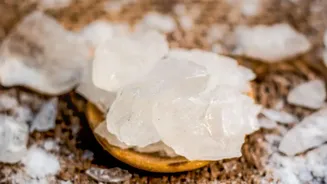
Once a nucleus has formed, it’s all about growth. More and more salt ions from the supersaturated solution are drawn to the seed crystal, snapping into place like puzzle pieces. Sodium chloride ions arrange themselves in a highly organized, repeating three-dimensional pattern known as a crystal lattice. This specific structure is what gives table salt its characteristic cubic shape. The crystal will continue to grow, layer by layer, as long as there are excess salt ions available in the solution. The rate of this growth can influence the final size of the crystals; slow evaporation tends to form larger, more perfect crystals, while rapid evaporation results in many smaller ones.
From Kitchens to Salt Flats
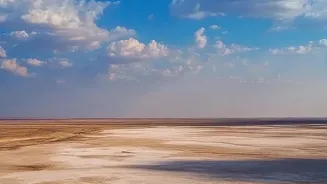
This very process is responsible for vast natural wonders and ancient industries. The massive salt flats of the Great Rann of Kutch are formed when the Arabian Sea floods the desert and the water evaporates under the intense sun, leaving behind a stunning white landscape of salt. On a commercial scale, this is known as solar evaporation and it's one of the oldest methods of salt production. Seawater is captured in large, shallow ponds, and the sun and wind do the work of evaporating the water, leaving the salt crystals to be harvested. It's a perfect example of chemistry at work on a grand scale.