




Your Eyes Are a Time Machine
It sounds like science fiction, but it’s one of the most fundamental truths of our universe. Everything you see is thanks to light, and light, while incredibly fast, has a finite speed. It travels at a staggering 2,99,792 kilometres per second. That means
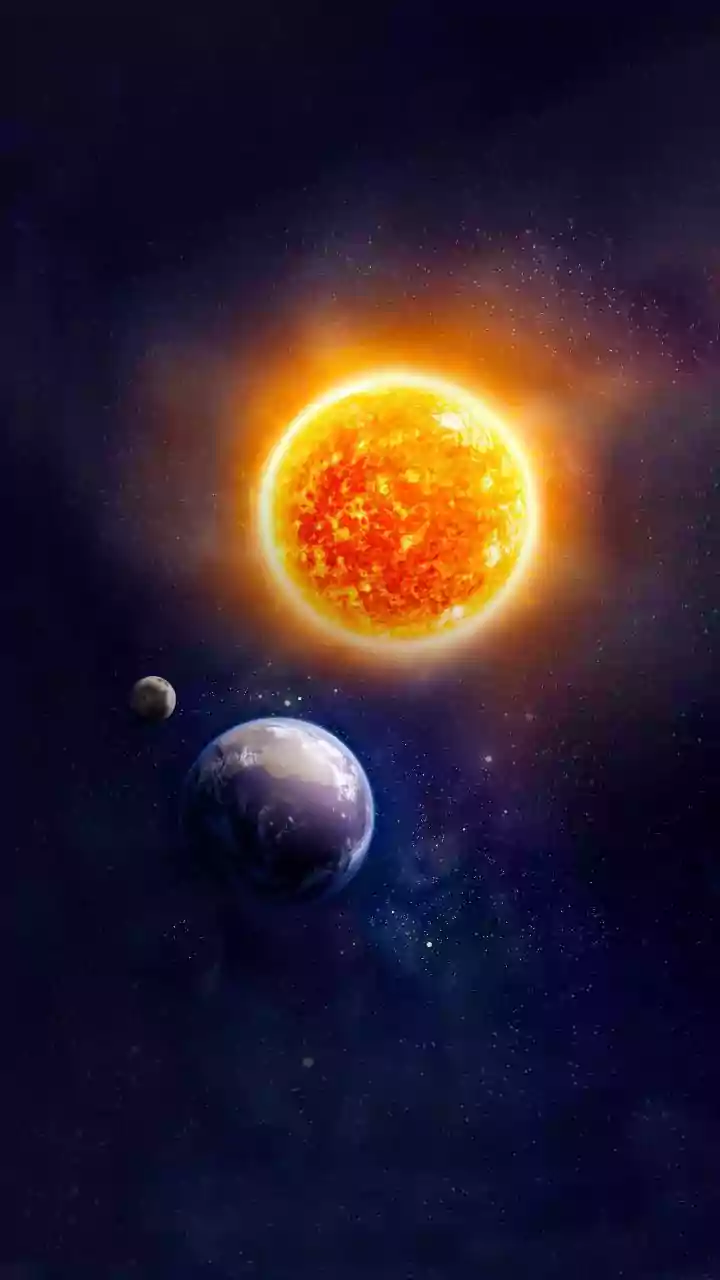
it takes time for light from any object to reach you. For a lamp across the room, that time is negligible. For the Sun, it’s about 8 minutes and 20 seconds. If the Sun were to suddenly vanish, we wouldn’t know for over eight minutes. Now, apply that same logic to the stars. They are immensely far away. So far, in fact, that measuring their distance in kilometres is impractical. Instead, astronomers use a unit called a 'light-year'—the distance light travels in a single year. That’s roughly 9.5 trillion kilometres. So when we say a star is 10 light-years away, we mean the light hitting our eyes tonight left that star 10 years ago. You are, quite literally, looking into the past.
Messages from the Recent Past
Let’s make this personal. One of the brightest stars in our night sky is Sirius, also known as the 'Dog Star'. It’s relatively close to us, astronomically speaking, at about 8.6 light-years away. The faint twinkle you see from Sirius tonight is light that began its journey around 2015-2016. Think about what was happening then. The world was gearing up for the Rio Olympics, ISRO was making headlines with its satellite launches, and the films *Dangal* and *Sultan* were dominating the box office. The light from Sirius carries no memory of these events, of course, but it has been travelling through the void of space during all the time that has passed since.
Go a little further out to Vega, another brilliant star in the constellation Lyra. It's about 25 light-years away. The light you see from Vega tonight left the star around 1999. That was the year India fought the Kargil War, the world was bracing for the Y2K bug, and *Hum Dil De Chuke Sanam* was a cinematic sensation. Every star is a portal to a different year.
Looking Back Centuries
The scale gets even more mind-bending. Consider Betelgeuse, the famous red supergiant in the Orion constellation. Its distance is harder to pin down, but most estimates place it between 500 and 600 light-years away. Taking a middle estimate of 550 light-years, the light we see from Betelgeuse today started its journey around the year 1474. At that time, the Lodhi dynasty ruled the Delhi Sultanate, Guru Nanak was a young boy, and Christopher Columbus hadn't even sailed to the Americas. The light from that single star has been travelling towards us through the rise and fall of empires, through revolutions in science, art, and technology, only to end its long journey in your eye.
This isn't just a fun fact; it's a powerful tool for astronomers. By looking at extremely distant objects, like galaxies billions of light-years away, they can study the universe as it was in its infancy. The James Webb Space Telescope, for instance, is designed to capture light from the very first stars and galaxies that formed over 13.5 billion years ago.
A Personal Connection to the Cosmos
This cosmic time delay transforms stargazing from a passive activity into an act of connection with history. You are not just seeing a star; you are receiving a postcard from the past. Each photon—each particle of light—that strikes your retina has completed an epic, lonely voyage across unimaginable distances. It’s a silent messenger that connects your fleeting present moment with the deep, ancient past of the cosmos.
This understanding doesn't diminish the beauty of the night sky. It enhances it. It adds a layer of intellectual and emotional depth to the simple, profound experience of looking up in wonder. The stars are not just distant suns; they are flickering candles of history, reminding us of the immense scale and timeline of the universe we are a small, but conscious, part of.