





A Tantalizing Target for a Super Telescope
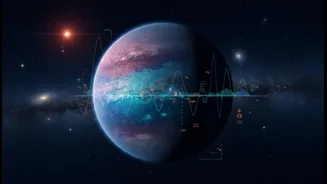
Located about 124 light-years from Earth, K2-18b is a type of planet known as a 'sub-Neptune'. It's larger than Earth but smaller than Neptune, and it orbits within the habitable zone of its cool red dwarf star. What makes it truly special are the observations
from the James Webb Space Telescope (JWST). Data from JWST revealed an atmosphere containing methane and carbon dioxide, consistent with a hypothetical 'Hycean' world — a planet with a hydrogen-rich atmosphere covering a global water ocean. Even more tantalizing was the potential detection of dimethyl sulfide (DMS), a gas that on Earth is overwhelmingly produced by life, particularly marine microbes like phytoplankton. This hint, though debated and not yet confirmed, has made K2-18b one of the most compelling places to look for life beyond our solar system.
The Challenge of Cosmic Imposters
Finding a potential biosignature like DMS is a monumental step, but it is far from proof of life. The biggest hurdle is the problem of 'false positives'—phenomena that can mimic signs of life without any biological origin. For example, energetic flares from a planet's host star can trigger chemical reactions in its atmosphere, creating gases that might be mistaken for biosignatures. Geochemical processes on the planet itself could also produce these gases. Scientists must be cosmic detectives, ruling out every possible non-biological explanation before they can claim to have found evidence of life. This process of verification is arguably the most critical and challenging part of astrobiology. The goal is to build an unshakeable case, and that requires looking at the system from multiple angles with different tools.
Radio Telescopes Join the Hunt
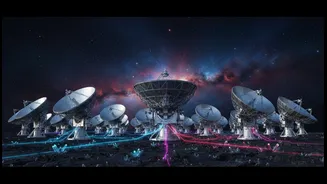
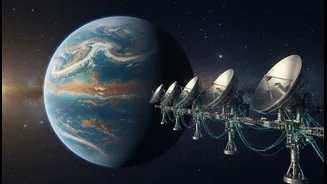
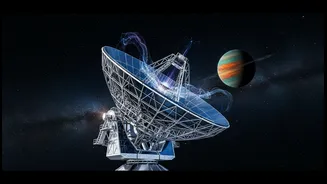
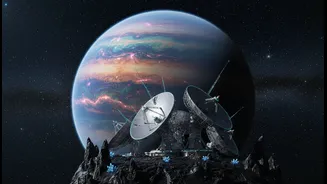
This is where radio surveys come in, though perhaps not in the way you might think. While some radio surveys of K2-18b have searched for 'technosignatures' — signals from intelligent alien technology — and found none, radio telescopes serve another vital role in vetting biosignatures like DMS. Instead of just looking at the planet, astronomers use powerful radio arrays like the Very Large Array (VLA) and MeerKAT to carefully monitor the planet’s host star. These telescopes are exceptionally good at detecting the telltale radio emissions associated with stellar magnetic activity, such as starspots and flares. By understanding the star's behaviour, scientists can determine if it's active enough to create false positives in the planet's atmosphere.
Decoding Stellar Silence and Activity
Recent radio observations of K2-18's star delivered a remarkable result: silence. The star was found to be unusually quiet, with no detectable radio emissions. This lack of activity is actually great news for the search for life. It suggests the star is not blasting its planet with intense radiation that could either strip the atmosphere away or create misleading chemical signals. This finding strengthens the case that K2-18b could indeed retain its atmosphere over long timescales. If, on the other hand, the radio telescopes had detected frequent, powerful flares that coincided with the appearance of the DMS signal in JWST's data, it would be a strong indicator of a false positive. By correlating data from different types of telescopes, astronomers can separate planetary signals from stellar interference, a crucial step in building confidence in any potential discovery.
A New Toolkit for Finding Life
The investigation of K2-18b showcases a new, more robust approach to the search for extraterrestrial life. It’s no longer about a single observation from one telescope. It’s about a coordinated effort, combining the power of instruments like JWST, which analyses atmospheric chemistry, with radio telescopes that characterize the stellar environment. Furthermore, the search for technosignatures involved developing sophisticated software to automatically filter out millions of interfering signals from Earth. Techniques included masking known human frequencies, accounting for Doppler shifts, and using multiple beams to distinguish between local noise and a true celestial signal. Though no alien broadcasts were found, these filtering methods have created a powerful new framework that will make future searches faster and more effective, especially as even larger telescopes come online.