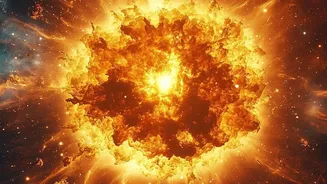





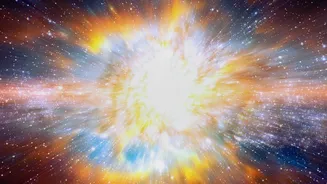
In October 1604, a brilliant point of light appeared where none had been before. It was the last supernova seen in our galaxy with the naked eye, and it didn't just dazzle stargazers—it provided the evidence that would shatter an ancient worldview.
A New Star in the Heavens
Imagine
looking up at the night sky and seeing a new star, brighter than any other, blazing in a familiar constellation. That was the reality in early October 1604, when observers across Europe and Asia noted a startlingly bright object in the constellation Ophiuchus. This 'new star', or 'stella nova' as it was called, was so luminous it outshone the planet Jupiter and was even visible during the day for several weeks. At a time when the cosmos was thought to be perfect and unchanging, its sudden appearance was a profound and shocking event that demanded explanation. Was it a miracle, an atmospheric event, or something else entirely?
Kepler's Meticulous Observations
While observers across the world recorded the event, it is German astronomer Johannes Kepler whose name is now inextricably linked with the supernova. Though not the very first to see it, Kepler began his detailed study on October 17 and tracked the object for over a year until it faded from view. Crucially, he did all of this without a telescope; Galileo would not point the newly invented device toward the heavens for another few years. Kepler meticulously documented the star's position and brightness, publishing his findings in a 1606 book, 'De Stella nova in pede Serpentarii' ('On the New Star in Ophiuchus’s Foot'). These careful, systematic measurements would become the key to unlocking the star's true significance.
Shattering an Ancient Worldview
The greatest legacy of the 1604 supernova was its role in dismantling a scientific idea that had stood for nearly two millennia. The prevailing model of the universe, based on the teachings of Aristotle and Ptolemy, held that the heavens beyond the Moon were perfect, eternal, and unalterable. Change could only occur in the imperfect, earthly sphere. By carefully measuring the 'new star' and observing its lack of parallax (an apparent shift in position against the background stars), Kepler and others demonstrated that it was located far beyond the Moon, in the supposedly immutable realm of the fixed stars. This fact, combined with observations of a supernova in 1572 by Tycho Brahe, provided powerful evidence that the heavens were not unchanging after all, helping to pave the way for the acceptance of new, sun-centered models of the cosmos.
What Kepler Actually Saw
At the time, astronomers believed they were witnessing the birth of a star. Centuries later, we know they were actually watching the spectacular death of one. Modern astronomers have identified SN 1604 as a Type Ia supernova. This type of cataclysmic event occurs in a binary star system, where a small, dense star called a white dwarf pulls so much material from a companion star that it reaches a critical mass and triggers a runaway thermonuclear explosion. This detonation is so powerful that it shatters the white dwarf and for a short time can outshine an entire galaxy. These explosions are also responsible for forging and scattering heavy elements into the universe.
The Remnant's Lingering Mysteries
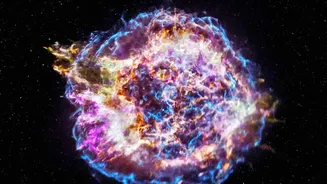
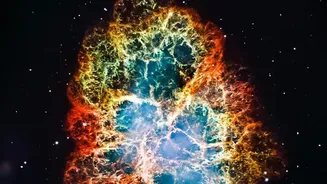
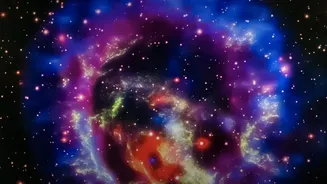
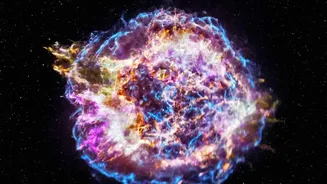
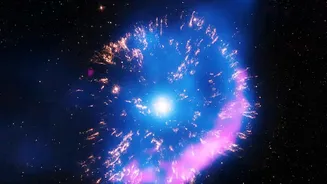
More than four centuries later, the legacy of Kepler's Supernova continues. Using modern instruments like NASA's Chandra X-ray Observatory and the Hubble and Spitzer Space Telescopes, astronomers study the expanding cloud of debris left behind by the explosion, known as a supernova remnant. This beautiful, glowing shell of gas, located about 20,000 light-years from Earth, is still expanding at incredible speeds—some pieces as fast as 23 million miles per hour. By studying the remnant's shape, composition, and speed, scientists can piece together details about the original explosion and the nature of Type Ia supernovae, which are themselves used as cosmic 'yardsticks' to measure the expansion of the universe.