

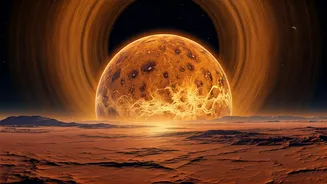
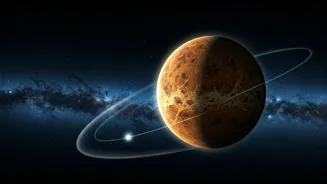


First, Let's Redefine 'Day' and 'Year'
To understand Venus, we first need to get specific about what we mean by a ‘day’ and a ‘year’. On Earth, these concepts feel simple, but they are two very different things. A ‘year’ is the time it takes for a planet to complete one full orbit around the Sun.
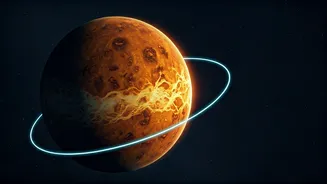
For Earth, that’s roughly 365 days. A ‘day’ is the time it takes for a planet to complete one full rotation on its own axis. For Earth, that’s about 24 hours. Venus completes its orbit around the Sun in about 225 Earth days. So, a Venusian year is significantly shorter than an Earth year. However, when it comes to its rotation, Venus takes its sweet time. It spins incredibly slowly, taking a mind-boggling 243 Earth days to complete just one turn on its axis. And there's the paradox: its day (243 Earth days) is longer than its year (225 Earth days).
The Bizarre Math of a Venusian Day
Here's where it gets even stranger. While a full rotation (a sidereal day) takes 243 Earth days, that’s not what a ‘day’ would feel like if you were standing on the surface. We tend to think of a day as the time from one sunrise to the next. This is called a solar day.
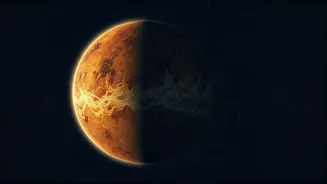
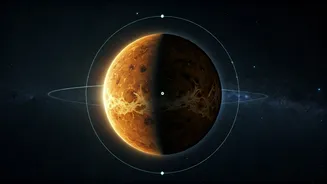
On Venus, because the planet is rotating backwards (a phenomenon called retrograde rotation) while it orbits the Sun, the time between sunrises is different. The slow backward spin, combined with its forward motion around the Sun, creates a peculiar effect. The result is that a solar day on Venus—the time from sunrise to sunrise—is about 117 Earth days long. So you’d experience roughly two full sun-cycles in a single Venusian year. The sun would also rise in the west and set in the east, the opposite of what we see on Earth.
Why is Venus So Weird?
Scientists are not entirely certain why Venus became the solar system's oddball, but there are two main theories. The first involves a cataclysmic past. Early in the solar system's history, about 4.5 billion years ago, the space was a chaotic shooting gallery of planet-sized objects. One theory suggests that a massive asteroid or protoplanet slammed into Venus with such force that it not only slowed its rotation to a crawl but actually flipped it completely upside down. This would explain its retrograde rotation.
The second leading theory points to Venus's own atmosphere. Venus has a crushingly thick, heavy atmosphere—over 90 times denser than Earth's. This dense blanket of gas creates powerful tidal forces, not from a moon, but from the Sun's gravity pulling on the atmosphere itself. Over billions of years, this atmospheric drag could have acted as a powerful brake, slowing the planet’s spin from a more 'normal' speed down to its current leisurely pace.
A Planet of Extremes
This ultra-slow rotation contributes to Venus being one of the most inhospitable places imaginable. The long days and nights aren't like Earth's gentle cycle. With a sunrise happening only every few months, the sun-facing side bakes under relentless solar radiation, while the night side endures a very long period of darkness. However, Venus’s thick atmosphere is brutally efficient at trapping heat. This runaway greenhouse effect means the entire planet is a uniform, scorching 465° Celsius, day and night. There is no cool relief after the sun sets. The combination of crushing pressure, acid rain, and extreme, uniform heat makes Venus a vision of a planetary environment gone wrong—a fascinating, but terrifying, cosmic sibling to our own world.